The wafer is placed below on a motorized stage so that it can be accurately positioned. The additional elements given in modern type play a critical role in improving features and performance. In the modern EBL, the simple thermionic electron gun is replaced with field emission source to supply a much higher current density. When an electron beam enters a resist coated wafer or any solid material, it loses energy via elastic and inelastic collisions known collectively as electron scattering as depicted in Figure 40.4. Elastic collisions result only a change of direction of the electrons, whereas inelastic collisions lead to energy loss. These scattering processes lead to a broadening of the beam as they penetrate the solid producing a transverse or lateral electron flux normal to the incident beam direction, and cause exposure of the resist at points remote from the point of initial electron incidence, which in turn results in developed resist images wider than expected. The magnitude of electron scattering depends on atomic number and density of both the resist and substrate as well as the velocity of the electrons or the accelerating voltage. Exposure of the resist by the forward and backscattered electrons depends on the beam energy, film thickness and substrate atomic number. It is not possible to deflect an electron beam to cover a large area in a typical EBL system and therefore mechanical stages are required to move the substrate. Stages can be operated either in a stepping mode or in a continuous mode to write the pattern. Figure 40.5 shows a typical scanning electron microscopy (SEM) images of a around 250 nm sized photonic crystals made by EBL and Inductively Coupled Plasma (ICP)-Reactive Ion Etching (RIE) [10].
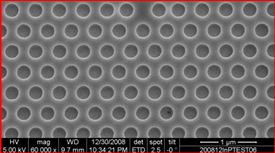
Figure 40.5: SEM image of photonic crystals made by EBL and Inductively Coupled Plasma (ICP)-Reactive Ion Etching (RIE). This work was done by Dr. Min-Hsiung Shih at the Research Center for Applied Sciences of Academia Sinica in Taiwan.