● Electron beam evaporation:
This is one of the suitable methods for the deposition of metals, alloys, refractory metals at a high deposition rate. Electron beam accelerated with a voltage of 2 - 10 kV is focused on the surface of the target, which is normally kept inside a graphite placed on water cooled copper black.
The high energy electron beam emitting from the cathode impinges on the target melts the charge. By suitably focusing the electron beam and controlling its intensity, it is possible to keep the target surface on molten stage, from which evaporation can takes place. As a result, a fresh surface evaporated every time for further melting and hence evaporation. Composition is obtained same as target. The temperature at the target surface could be obtained about 3000 oC or more. So, one can melt even W, Mo, and Ta etc and make films by this technique.
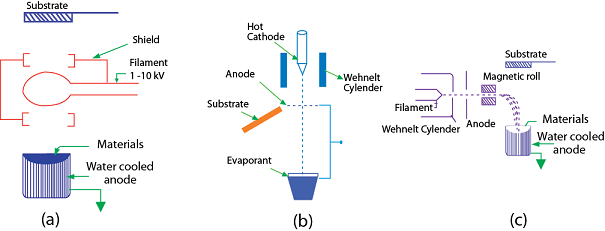
Figure 40.1: Schematic diagrams of electron beam guns (a) work accelerated, (b) self accelerated, and (c) bent beam type.
There are three types of electron-beam guns:
1. Work accelerated: Electron beam coming out of a loop type filament is accelerated directly towards the material (or) through an appropriate shield thus concentrating the beam (see Figure 40.1a).
2. Self accelerated: Electrons are emitted from hair-pin type of filament and focused through Wehnelt-cylinder on the material (see Figure 40.1b) to evaporate and deposit films.
3. Bent beam electron gun: Electron beam is bent by an appropriate magnetic field as shown in Figure 40.1c and then focused on the materials (to be deposited as thin film). This technique is commonly used in all the recent e-beam evaporation process.