Spin polarization of the injected current = 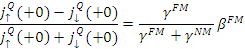 |
(14) |
| where,
|
(15) |

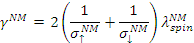
Here, +0 indicates the position at the right-hand side of the interface, ↑ and ↓ are the up and down spins in the NM, respectively, and the up (down) spin in the NM is parallel to the majority (minority) spin in the FM.  (
( ) is the electric conductivity at the majority (minority) spin sub-channel in the FM. σNM is the total electric conductivity of the NM. ßFM is the spin asymmetry of the electric conductivity in the FM. A large ßFM results in large spin polarization of the injected current.
  (
( ) is the spin diffusion length in the FM (NM). γFM (γNM) expresses the difficulty in spin injection into the FM (NM) and is often regarded as the “spin (interface) resistance”. Eqn.(15) suggests that spin injection from a FM to a NM is difficult if γNM >> γFM. For example, if NM is a semiconductor and FM is a FM metal, larger resistivity and spin diffusion length in the semiconductor provides a much larger spin resistance than that in the FM metal. Therefore, spin injection from the FM to the NM will be difficult. This problem is known as “the conductance mismatch problem” [6]. Spin accumulation at the interface is obtained as follows:
Spin accumulation =  |
(16) |
Here, NNM is the total density of states at Fermi energy in the NM. If NM is a semiconductor, NNM should be replaced by ±n/(kBT), where n is the total carrier density and +(–) is for electrons (holes). Spin accumulation can be large if NNM and ßFM are large, and both γFM and γNM are of the same order of magnitude. Therefore, a large spin accumulation is expected if both layers are the same kind of materials.
One of the ways to overcome the conductance mismatch problem of spin injection into a semiconductor is to use a FM semiconductor as a spin source [1,7]. FM GaMnAs was used by Ohno et al [1] as a spin source to inject spin-polarized holes into an InGaAs layer through a GaAs layer. They observed about 10% circular polarization of the emitted light at 6 K and could conclude a significant spin polarization (more than about 20%) of the injected carriers. Another possible way to inject spins into semiconductors is to insert a spin-dependent interface resistance [8].