Now, we shall see the effect of current passing through the interface between a FM and a NM as shown in Figure 28.3a. Consider two sections A and B in the FM layer and the NM layer, respectively, in the junction and assume that both A and B are sufficiently far enough from the interface. The spin current should be finite at A in the FM but zero at B in the NM as consequences of eqn.(4). Then, from the conservation law of spin momentum (eqn.(2)), it is expected that the spins will accumulate around the interface with time. In reality, spin accumulation does not grow indefinitely and the accumulated spins are lost through spin–orbit interaction. To consider this effect into account, spin relaxation terms are added into eqn.(2):
|
|

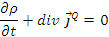
where  and
and  are the spin relaxation time and spin density in the thermal equilibrium condition in each spin sub-channel. Since the density of states at the Fermi energy in metals, N±, and the carrier density in semiconductors, n±, are different for different spin sub-bands, the spin relaxation times are also different and are related as follows:
|
|


The accumulated spins also flow from the interface to the bulk by diffusion resulting in a diffusion spin current (Figure 28.3b):
|
(7) |
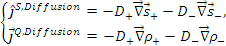
where D± is the diffusion constant of the electron in each spin sub-channel. The Einstein relation holds between the diffusion constants and the conductivities:
|
(8) |


The gradient of the electron density in each spin sub-channels can be expressed by using spin-dependent chemical potentials, μ±, as follows:
|
(9) |

