The above equation helps easily to pinpoint the main factors that determine the GMR. Also, eqn.(25.2) clearly suggests that the
(1) ( ΔR / R ) is a function of two variables, β and ( Mμ / N ).
(2) For a given value of β, GMR increases with increasing ( Mμ/ N ) values and saturates eventually.
(3) On the other hand, the GMR value decreases with increasing the thickness of the space layer, i.e., the GMR falls as (1/N2 ) as shown in the Figure 4 for the Fe/Cr multilayers on the thickness of the non-magnetic chromium layer, described by Parkin in his original experiment [2].
Figure 25.4: Variation of GMR ratio with the non-magnetic Cr layer thickness in Fe/Cr multilayer films. The dotted line indicates the variation as (1/N 2 ) [2]. |
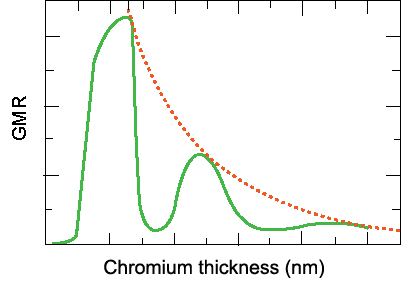
The oscillations of the GMR as a function of the chromium thickness occur because the MR effect is measurable only for those thicknesses of chromium for which the interlayer exchange coupling aligns the magnetic moments of all the iron layers antiparallel.
GMR Head Design :
Since the multilayer structured films, composed of alternating FM and NM layers, need a large saturation field to obtain considerably a large MR ratio, they are difficult to implement in a recording head device. This motivated the researchers to find an alternative GMR structure. Dieny et al proposed the GMR in soft ferromagnetic multilayers [5]. This multilayer structure consists of two FM layers (NiFe) separated by a NM layer (Cu) and the magnetization of the top FM layer is pinned with AFM layer (FeMn) through the exchange interaction. This arrangement helps to saturate the sample in much lower field, as the magnetic interaction between the FM and AFM layers are much weaker than that in the GMR multilayers. These GMR sandwiches are called as “Spin valves”. The details about the Spin valve structure and the GMR head using spin valve structure are discussed in the next lecture.
References:
[1]. M.N. Baibich et al, Phys. Rev. Lett. 71 (1988) 2472.
[2]. S.S.P. Parkin et al, Phys. Rev. Lett. 64 (1990) 2304.
[3]. A. Fert and I.A. Campbell, J. Phys. F: Metal Physics 6 (1976) 849.
[4]. J. Mathon, Phenomenological Theory of Giant Magnetoresistance, in Spin Electronics (Lecture Notes in Physics), Eds: M. Ziese, M.J. Thronton, Springer, New York, 2001.
[5]. B. Dieny et al, Phys. Rev. B 43 (1991) 1297.