Giant MR (GMR) is a quantum mechanical MR effect observed in multilayer thin-film structures composed of alternating ferromagnetic (FM) and non-magnetic (NM) layers [1]. The effect of large MR is observed due to the significant change in the resistance depending on whether the magnetization of adjacent FM layers are in a parallel or an antiparallel orientations. This revealed that the internal moment of the electrons associated with their spin plays an important role in the transport of electric charge. The discovery of GMR triggered the field of spintronics and in 2007 the Nobel Prize in physics was awarded to Albert Fert and Peter Gurnberg for the discovery of GMR.
Resistance change in multilayer structure:
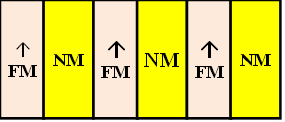
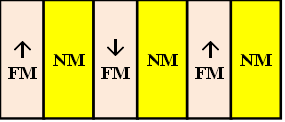
Figure 25.1 shows the typical multilayer structure consisting of a sequence of thin FM layers separated by equally thin NM metallic layer. The resistance of the magnetic multilayer is low when the magnetizations of all the FM layers are parallel (see Figure 25.1a) and the resistance become much higher when the magnetizations of the neighbouring FM layers are ordered antiparallel (Figure 25.1b).
(a) |
(b) |
Figure 25.1: (a) Ferromagnetic and (b) antiferromagnetic configurations of magnetic multilayers film. |
|
The definition of GMR ratio varies slightly in the literature. In order to be consistent with the AMR ratio, the definition of GMR ratio is defined as the ratio of the maximum change in resistance over the minimum resistance observed in the parallel configuration, as written in eqn.(25.1).
|
(25.1) |

where R↑↓ ( G ↑↓ ) and R ↑↑ ( G ↑↑ ) are the resistance (conductance) of the multilayer film in antiferromagnetic (AFM) and FM configurations, respectively. The most commonly used combinations of magnetic and non-magnetic layers are cobalt–copper and iron–chromium.