Nuclear Magnetic Resonance Spectroscopy:
Since a nucleus is a charged particle in motion, it will develop a magnetic field. For instance, 1H and 13C have nuclear spins of ½. Hence, they would behave in a similar fashion to a simple, tiny bar magnet.
As shown in Figure 35.01, in the absence of magnetic fields, these are oriented randomly. On the other hand, the application of external magnetic field lines up them parallel to the applied field, but either spin aligned or spin opposed.
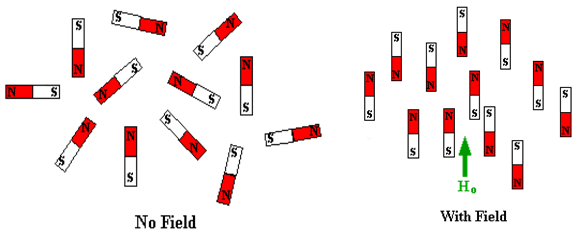
Figure 35.01: Schematic representation of nuclear spins or in the form of tiny magnets under zero and finite magnitude of external applied fields.
As displayed in Figure 35.02, the highly populated state is the lower energy spin aligned situation.