Introduction:
• Electrical property of the materials is one of the most important properties, which helps to classify the materials. For instance, solids may be classified in terms of their resistivity or conductivity as conductors, semiconductors or insulators.
• The electrical resistivity, an intrinsic property that quantifies how strongly a given material opposes the flow of electrical current, can be measured using several ways depending on the magnitude of the resistance involved in the materials. Two general methods involved for measuring the resistance of the materials are:
• Two-probe method
• Four-probe method
• Based on the above methods, the materials are ranged over 25 orders of magnitude as shown in Figure 24.01. We shall discuss the principles involved for the measurements of resistivity in next few slides.
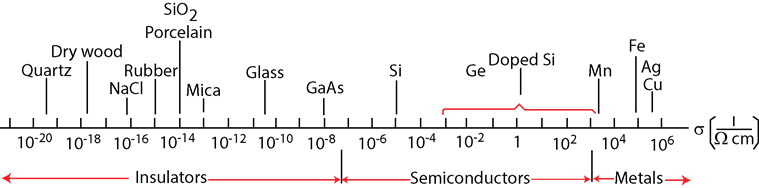
Figure 24.01: Conductivity of the materials.