5.3 Grand canonical ensemble ( μ,V,T) : Consider a system in contact with an energy reservoir as well as a particle reservoir and the system could exchange energy as well as particles (mass) with the reservoirs. Canonical ensemble theory has limitations in dealing these systems and needs generalization. It comes from the realization that not only the energy E but also the number of particles N of a physical system is difficult to measure directly. However, their average values,  and
and  , are measurable quantities. The system interacting with both energy and particle reservoirs comes to equilibrium when a common temperature T and a common chemical potential μ with the reservoir is established. In this ensemble, each microstate (r, s) corresponds to energy
  and number of particles
  in that state. If the system is in thermodynamic equilibrium at temperature T and chemical potential μ, the grand canonical partition function is given by

where  is the fugacity of the system. In case of a system of continuous energy levels, the grand partition function can be written as

Note that division by  is only for indistinguishable particles.
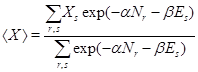
The expectation value of a thermodynamic quantity  is given by
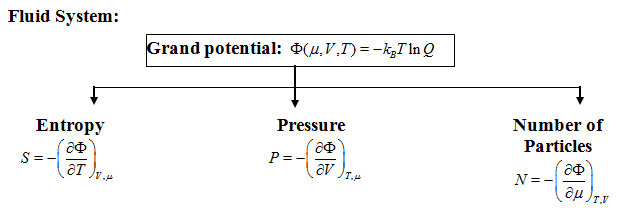
The grand potential  is the appropriate potential or free energy to describe the thermodynamic system in equilibrium with temperature T and chemical potential μ. It can be shown that

All equilibrium thermodynamic properties can now be calculated by taking appropriate derivatives of the grand potential  with respect to its parameters as given below.
In the table below, statistical quantities and the corresponding thermodynamic functions in cases of different ensembles are given. Thermodynamic quantities and response functions are different derivatives of these potential functions.
Ensemble |
Statistical quantity |
Thermodynamic functions |
Microcanonical |
Number of microstates: |
Entropy: |
Canonical |
Canonical partition function: |
Helmholtz free energy:
|
Grand Canonical |
Grand partition function: |
Grand potential: |


