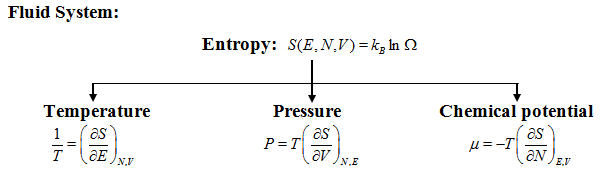
6.2 Canonical ensemble (N,V,T) :In the micro-canonical ensemble, a macrostate was defined by a fixed number of particles N, a fixed volume V and a fixed energy E. However, the total energy E of a system is generally not measured. Furthermore, it is difficult to keep the total energy fixed. Instead of energy E, temperature T is a better alternate parameter of the system which is directly measurable and controllable. Let us consider an ensemble whose macrostate is defined by N, V and T. Such an ensemble is known as canonical ensemble. In the canonical ensemble, the energy E can vary from zero to infinity. The set of microstates can be continuous as in most classical systems or it can be discrete like the eigenstates of a quantum mechanical Hamiltonian. Each microstate s is characterized by the energy  of that state. If the system is in thermal equilibrium with a heat-bath at temperature T, then the probability
  that the system to be in the microstate s is
  , the Boltzmann factor. The canonical partition function Z is the sum of the Boltzmann factor over all possible microstates

where  . The expectation (or average) value of a macroscopic quantity X is given by
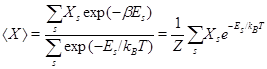
where  is the property X measured in the microstate s.
In the classical limit, the consecutive energy levels are very close and can be considered as continuous. In this limit, the canonical partition function can be written as

(  is for indistinguishable particles only) and the expectation value of X is given by

Helmholtz free energy  is the appropriate potential or free energy to describe the thermodynamic system when the system is in thermal equilibrium with a heat-bath at temperature T. It can be shown that the Helmholtz free energy
  of the system is related to the logarithm of the partition function
  and it is given by
