


Next: Supplementary information Up: Module4 Previous: Tutorial problems and questions
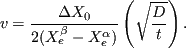

Consider Eq. 55
 |
(16) |
 |
(17) |
 |
(18) |
 |
(19) |
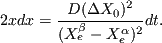
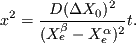
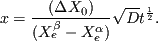
This is Eq. 56. To obtain Eq. 57,
let us start with the above equation and differentiate it with respect to time:
 |
(20) |
 |
(21) |
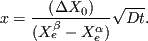
Thus, we obtain the Eq. 57:
 |
(22) |
|
(23) |
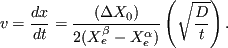
is known as the diffusion distance. This distance
is temperature dependent because D is temperature depdendent. Hence, let
us calculate the diffusion distance at T2 and T3.
Given:
D = 1.2 x 10
 m
m /sec and Q = 150 kJ/mol.
Also,
/sec and Q = 150 kJ/mol.
Also,
 where R is the universal gas constant.
Hence, D (T2 = 650K) =
 = 1.06 x 10
 and, D(T3= 600K) = 1.05 x 10
 .
Thus, the diffusion distance at 650 K is nearly 14 microns while it is about 4 microns at 600 K.
.
Thus, the diffusion distance at 650 K is nearly 14 microns while it is about 4 microns at 600 K.
is 0.15 (that is, 0.25-0.1) 650 K and 0.25 (that is, 0.25-0) at 600 K.
Further,
 is 0.8 (that is, 0.9-0.1) at 650 K, and is 1.0 (that is, 1.-0.)
at 600 K.
is 0.8 (that is, 0.9-0.1) at 650 K, and is 1.0 (that is, 1.-0.)
at 600 K.
Hence, at 650 K, the growth is about 2.6 microns while at 600 K, the growth is about 1.1 microns.
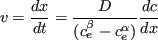 . However,
when two precipitates are close, their diffusion fields overlap. Because of this, the
decreases much more rapidly then when there is only one precipitate. So, in the case where the diffusion
fields overlap, the growth rate decelerates much more rapidly and hence the growth rate deviates from
that given by Eq. 57.
. However,
when two precipitates are close, their diffusion fields overlap. Because of this, the
decreases much more rapidly then when there is only one precipitate. So, in the case where the diffusion
fields overlap, the growth rate decelerates much more rapidly and hence the growth rate deviates from
that given by Eq. 57.
| [scale=0.4]Figures/GBAllotriomorphSolution.pdf |