Next: Consequences of Eq. 56 and 57 Up: Module 4. Growth of Previous: Motivating question/phenomenon
Consider an alloy of composition c which is cooled from a high temperature into
a two phase region as shown in Figure. 22. At this temperature,
the alloy phase separates into two phases, say,
which is cooled from a high temperature into
a two phase region as shown in Figure. 22. At this temperature,
the alloy phase separates into two phases, say,  and , with
equilibrium compositions given by c
and , with
equilibrium compositions given by c and c
and c . Let us consider
the phase separation that takes place by the nucleation
and growth mechanism. Suppose the phase has nucleated and is growing into the
supersaturated phase; we assume that the - boundary is planar and
incoherent. Our aim, in this section, is
to calculate the velocity of such a planar, incoherent boundary using an approximate
method due to Zener (Theory of growth of spherical precipitates from solid solution, C. Zener,
Journal of Applied Physics, Vol. 20, pp. 950-953, 1949).
. Let us consider
the phase separation that takes place by the nucleation
and growth mechanism. Suppose the phase has nucleated and is growing into the
supersaturated phase; we assume that the - boundary is planar and
incoherent. Our aim, in this section, is
to calculate the velocity of such a planar, incoherent boundary using an approximate
method due to Zener (Theory of growth of spherical precipitates from solid solution, C. Zener,
Journal of Applied Physics, Vol. 20, pp. 950-953, 1949).
| [scale=0.4]Figures/GrowthSchematic.pdf |
In Figure. 22 we also show, schematically, the microstructure; the
two phases and are separated by a planar interface. We also show the
composition profile as we go from the precipitate into the superaturated matrix.
The composition of the phase is c as
given by the phase diagram. However, on the side the composition is not a constant.
On the side, at the interface, the composition of the phase is c
as given by the phase diagram. Far from the - interface, the composition of
the phase is the same as the initial alloy composition, namely, c. In the middle region,
the composition changes from c to c in a continuouos manner. This
composition profile is schematically shown in the Figure. 22; this profile
results due to the diffusion of B atoms in the phase.
Consider a unit cross-section of the - interface which moves a small distance, say,
 in a given time, say,
  . The number of B atoms needed for such a movement of the interface is given by
 . Since these B atoms are supplied to the interface by diffusion, using
the Fick's first law, one can calculate the number of B atoms that diffuse in time as
. Since these B atoms are supplied to the interface by diffusion, using
the Fick's first law, one can calculate the number of B atoms that diffuse in time as
 where
where  is the interdiffusion coefficient. Equating these two quantities, one can obtain the velocity
of movement
is the interdiffusion coefficient. Equating these two quantities, one can obtain the velocity
of movement  of the interface as follows:
| [scale=0.4]Figures/ZenerApprox.pdf |
As the precipitate grows, 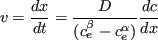 keeps decreasing - and hence, more and more
of the matrix regions participate in the diffusion process to supply B atoms to grow
the precipitate. As noted earlier, Zener introduced a simplified profile
to calculate the velocity approximately.
This simplified profile is shown in Figure. 23.
From the profile, clearly,
keeps decreasing - and hence, more and more
of the matrix regions participate in the diffusion process to supply B atoms to grow
the precipitate. As noted earlier, Zener introduced a simplified profile
to calculate the velocity approximately.
This simplified profile is shown in Figure. 23.
From the profile, clearly,
 .
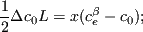
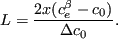
The value of L can be calculated using conservation of B atoms, which demands that the shaded
rectangle on the left is equal in area to the shaded triangle on the right. Hence,
.
The value of L can be calculated using conservation of B atoms, which demands that the shaded
rectangle on the left is equal in area to the shaded triangle on the right. Hence,
 |
(2) |
 |
(4) |
Further simplifications are possible if we assume that the molar volumes of both the phases are
the same - in which case, we can replace the concentrations by mole fractions (X = C V ). Also,
we can assume, for the sake of simplicity,
). Also,
we can assume, for the sake of simplicity,
 .
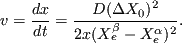
Thus, we obtain,
.
Thus, we obtain,
The expression in Eq. 55 can be integrated to obtain
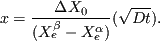 .
.
Now, the expression in Eq. 56 can be differentiated to obtain the velocity as