


Next: Interface structure and growth Up: Module 4. Growth of Previous: Precipitate growth kinetics: Diffusion
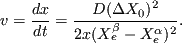
Let us consider Eq. 56:
 |
(8) |
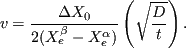 . In other words, the thickeninng of the precipitate is parabolic. As we
have seen earlier such a parabolic growth is a common feature of all diffusion limited
growth. Although this conclusion is derived under simplifying assumptions, more thorough
treatments and allowing for curved boundaries do not change this conclusion: the linear
dimensions of a spheroidal precipitate increases as as long as the interface
migration is diffusion controlled.
. In other words, the thickeninng of the precipitate is parabolic. As we
have seen earlier such a parabolic growth is a common feature of all diffusion limited
growth. Although this conclusion is derived under simplifying assumptions, more thorough
treatments and allowing for curved boundaries do not change this conclusion: the linear
dimensions of a spheroidal precipitate increases as as long as the interface
migration is diffusion controlled.
Let us consider Eq. 57:
 |
(9) |
 as
well as to
as
well as to  (the supersaturation at the beginning of the precipitation).
From the phase diagram, it is clear that increases with increasing superaturation.
Thus, as undercooling increases, the velocity of the precipitate-matrix interface should increase.
However, the diffusivity is high at high temperatures and low at lower temperatures. In other words,
the diffusivity gives lower velocities at higher undercoolings. Hence, the
velocity of the precipitate-matrix interface is high at intermediate undercooling as shown in
Fig. 24.
| [scale=0.4]Figures/VelocityTemperature.pdf |