Tutorial problems and questions

  1. The incoherent planar boundary that separates a precipitate and matrix thickens as
    (a)
    $\sqrt{Dt}$
    (b)
    $\sqrt{\frac{D}{t}}$
    (c)
    $Dt$
    (d)
    $\frac{D}{t}$

  2. With increasing undercooling, the growth velocity of a precipitate-matrix interface
    (a)
    increases and hence peaks at highest undercooling
    (b)
    decreases and hence peaks at lowest undercooling
    (c)
    increases and then decreases and hence peaks at intermediate undercooling
    (d)
    decreases and then increases and hence peaks at both highest and lowest udercoolings

  3. The growth rate of an incoherent, planar precipitate-matrix interface is proportional to
    (a)
    $\Delta X_0$
    (b)
    $(\Delta X_0)^2$
    (c)
    $\frac{1}{\Delta X_0}$
    (d)
    $\frac{1}{(\Delta X_0)^2}$

  4. In general,
    (a)
    the mobilities of coherent and incoherent boundaries are the same
    (b)
    the mobility of coherent boundary is lower than that of incoherent boundary
    (c)
    the mobility of incoherent boundary is lower than that of coherent boundary

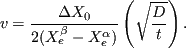
  5. Derive Eq. 56 from Eq. 55 by integration, and Eq. 57 from Eq. 56 by differentiation.

  6. Consider the phase diagram shown in Fig. 29. Let T1, T2 and T3 be 1000, 650 and 600 K, respectively. Consider two pieces of an alloy of composition 0.25; let one be cooled from T1 to T2 and kept at T2 for about 2 minutes while the other is cooled from T1 to T3 and kept at T3 for about 2 minutes. Assuming incoherent and planar boundary between nuclei and supersaturated $\alpha $ phase, calculate the increase in length of the precipitates in these two cases. The relevant diffusivity data is as follows: D$_0$ = 1.2 x 10$^{-2}$m$^2$/sec and Q = 150 kJ/mol.
    Figure 29: Schematic phase diagram to show the heat treatment. The overall alloy composition is 0.25. In one case, the alloy is cooled from T1 to T2 and is kept at T2 for 5 hours. In the other, the alloy is cooled from T1 to T2 and is kept at T3 for 5 hours.
    [scale=0.4]Figures/ProblemPhaseDia.pdf

  7. Consider the growth of two precipitates which are close to each other as shown in the schematic (Fig. 30). Can Eq. 57 be used to describe the growth of these two precipitates? Explain.
    Figure 30: Two precipitates close to each other in a supersaturated $\alpha $ matrix growing with planar, incoherent boundaries.
    [scale=0.4]Figures/ProblemDiffFieldOverlap.pdf

  8. Consider the growth of a precipitate nucleated at the grain boundary of two $\alpha $ grains. Explain the growth of such a precipitate assuming that the solute diffuses substitutionally. Would the growth process be different if the solute diffuses interstitially?

Guest 2013-07-05