3. Strain Gauge as force Sensor
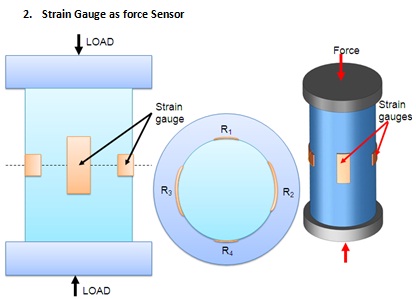 |
Figure 2.4.5 Strain gauge based Load cell |
Strain gauge based sensors work on the principle of change in electrical resistance. When, a mechanical element subjects to a tension or a compression the electric resistance of the material changes. This is used to measure the force acted upon the element. The details regarding the construction of strain gauge transducer are already presented in Lecture 2 of Module 2.
Figure 2.4.5 shows a strain gauge load cell. It comprises of cylindrical tube to which strain gauges are attached. A load applied on the top collar of the cylinder compress the strain gauge element which changes its electrical resistance. Generally strain gauges are used to measure forces up to 10 MN. The non-linearity and repeatability errorsof this transducer are ±0.03% and ±0.02% respectively.
4. Fluid pressure
Chemical, petroleum, power industry often need to monitor fluid pressure. Various types ofinstruments such as diaphragms, capsules, and bellows are used to monitor the fluid pressure. Specially designed strain gauges doped in diaphragms are generally used to measure the inlet manifold pressure in applications such as automobiles. A typical arrangement of strain gauges on a diaphragm is shown in figure 2.4.6. Application of pressurized fluid displaces the diaphragm. This displacement is measured by the stain gauges in terms of radial and/or lateral strains. These strain gauges are connected to form the arms of a Wheatstone bridge.