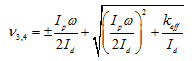
From equation (5.57), we have
 |
(a) |
with

where the positive sign for the forward whirl and the negative sign for the backward whirl. On substituting values in equation (a), we get

which gives

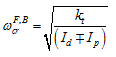
It should be noted that these natural whirl frequencies change with the spin speed of the rotor.For obtaining the forward and backward critical speeds, respectively, following conditions, i.e.ω = v and ω = -v , to be used. On substituting these conditions in equation (a), one at a time, we get the following expression for critical speeds
 |
(b) |
where the negative sign is for the forward critical speed,  , and the positive sign for the backward critical speed,
 . It should be noted from equation (b) that for Id < Ip, the term in side the square bracket will be negative and there would not be any forward critical speed. For the present case, we have Id > Ip and the corresponding critical speeds are
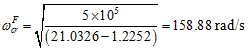
and
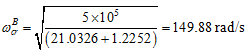
Hence, the rotor is operating well above the critical speeds, since operating speed is 1047.2 rad/s. That means if we consider perfectly balanced rotor that is rotating at 1047.2 rad/s and if we perturb the rotor in forward whirl it will have whirl frequency equal to 187.67 rad/s. Moreover, if we perturb the rotor in backward whirl it will have whirl frequency equal to 126.67 rad/s.While rotor is coasting up during the passage of critical speeds large oscillations are expected. An alternative solution of the present problem will be presented in subsequent section based on dynamic analysis by considering the formulation of governing differential equations of the rotor.
When no gyroscopic effect is considered, v3 and v4 remain the same; and from equation (a) for Ip = 0, we get
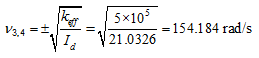
which is between the forward and backward whirl frequencies (187.67, 126.67) rad/s obtained by considering the gyroscopic effect and these frequencies are now independent of the rotor spin speed.
If we consider the pure linear (translational) motion, then the critical speed will not experience any gyroscopic moments, hence corresponding critical speeds can be obtained as

with

where d is the diameter of the cylinder. In this case the natural frequency does not change with the spin speed of the rotor, and remains equal to the critical speeds (90.34 rad/s) as obtained above.
Answer.