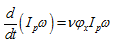
Equation (5.53) can be rearranged as
 |
(5.54) |
Equation (5.54) gives the gyroscopic moment. The elastic moment due to the springs kt is equal to ktφx and the total moment is equal to
 |
(5.55) |
where the positive sign for a whirl in the same sense as the rotation, and the negative sign for a whirl in the opposite sense. In equation (5.55), the term in the parenthesis is the equivalent spring constant and hence the natural whirl frequency will be (for the synchronous whirl)
 |
(5.56) |
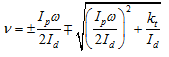
where Id is the diametral mass of whole motor assembly (including frame and disc). The solution of equation (5.56) can be given as
 |
(5.57) |
From equation (5.57), it can be observed that the natural frequency of rotor system depends upon the spin speed of rotor, ω. The ± sign before the square root, only the positive sign need to be retained since the negative sign gives two values of ωnf, which are both negative, and equal and opposite to the two positive roots obtained with positive sign before the square root. This is due to the fact that natural frequencies remain same for the spining of rotor in either direction. Let us define non-dimensional terms as the frequency ratio as
 be the non-rotating shaft natural frequency, i.e. without the gyroscopic effect; and the spin ratio
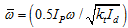 . Equation (5.57) takes the following form
 |
(5.58) |
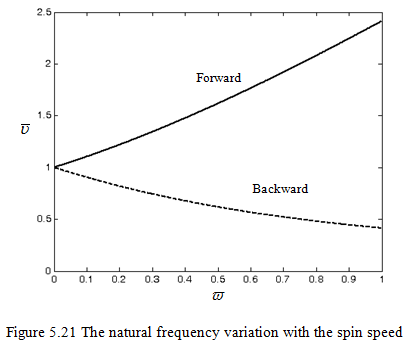
Figure 5.21 shows the variation of the non-dimensional natural frequency,  , with the non-dimensional speed,
 , which govern by equation (5.58). It is seen that the natural frequency is split into two frequencies on account of the gyroscopic effect (i) a slow one whereby the whirl is opposed to the rotation (i.e. the backward whirl) and (ii) a fast one where the whirl and rotation directions are the same (i.e., the forward whirl). It can be seen that we will have two critical speeds one corresponding to the forward whirl and another backward whirl. These critical speeds can be obtained by the condition that whenever the spin speed is equal to the natural frequency we will have critical speeds. It will be illustrated in the following numerical example.
Example 5.3 A long rigid symmetric rotor is supported at ends by two identical bearings. Let the shaft has the diameter of 0.2 m, the length of 1 m, and the material mass density equal to 7800 kg/m3. The bearing has dynamic parameters as follows: kxx = kyy = k = 1 kN/mm with other stiffness and damping terms equal to zero. By considering the pure tilting motion and the gyroscopic effect, obtain whirl natural frequencies of the system, if rotor is rotating at 10, 000 rpm. Obtain also the forward and backward critical speeds of the rotor-bearing system. Compare the critical speeds of rotor without considering the gyroscopic effect.
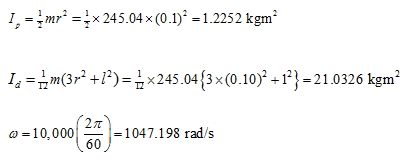
Solution: For the circular cylinder the polar moment of inertia, Ip, and the diameter moment of inertia, Id, are given as

where m is the mass of the cylinder, r is the radius of the cylinder, and l is the length of the cylinder. For the pure tilting motion of the rotor, we have the following rotor properties
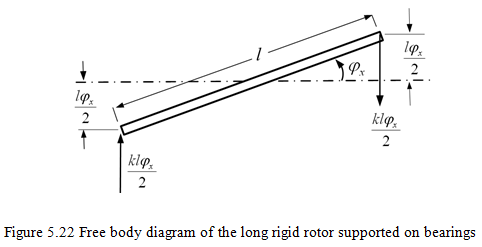
The effective torsional stiffness due to bearings on the rotor can be obtained by considering Figure 5.22. A long rotor is supported at ends by two identical bearings; consider pure tilting of the rotor by an angle φx, which gives 0.5lφx compression of the left bearing and the same amount of extension of the right bearing. This produces reaction forces at bearings with the magnitude of 0.5klφx and the direction as shown in Figure 5.22. The moment on to the rotor due these bearing forces would be 0.5kl 2φx. Hence, the effective torsional stiffness would be 0.5kl 2.