5.4 Asynchronous Rotational Motion
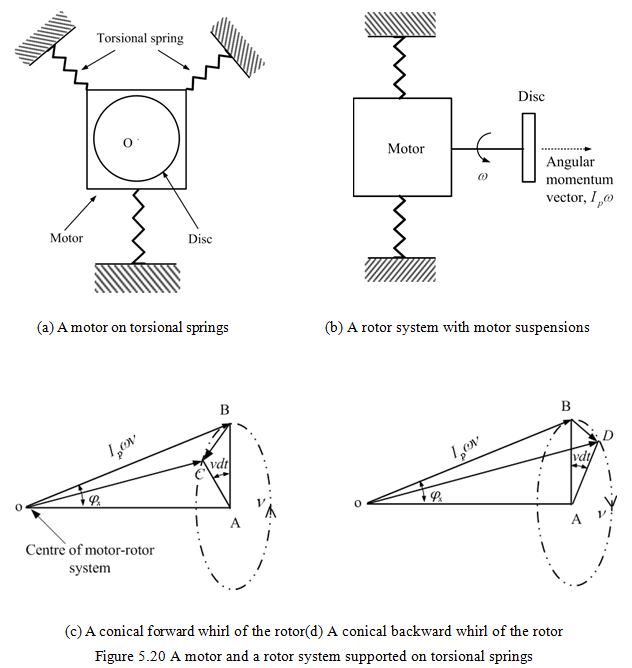
In this section we will consider the asynchronous whirling motion of the spinning rotor. Consider a rotor, which is suspended practically at its centre of gravity by very flexible torsional springs as shown in Figure 5.20. The shaft and the disc are assumed to be rigid (i.e., their flexibility has been ignored). This will enable us to analyse the effect of rotational displacement of the rotor on its whirling frequencies, without complicating with the general motion in which both the linear and angular displacements take place simultaneously. Such general motion is quite complicated and will be considered in subsequent sections.
The aim is to calculate natural frequencies of modes of motion for which the centre of gravity O of the whole suspended system (including the motor and the rotor) remain at rest and the shaft whirls about O in a cone of angle 2φx. Let the effective torsional stiffness of the support be kt . The disc on the motor shaft rotates very fast, and as the springs on which the motor is mounted are flexible, the whirling take place at a very slow rate, n, than the shaft rotation, w. The angular momentum, H, is given as
 |
(5.52) |
where Ip is the polar mass moment of inertia of the rotor (i.e., rotating parts of the motor, shaft and the disc). In the case when the whirl is in the same direction as the rotation (i.e., the forward whirl), the time rate of change of angular momentum will be directed from B to C (i.e., out of the plane of paper in Figure 5.20(c)). This is equal to the moment applied by the motor frame to the disc. The reaction, i.e. the moment acting on the motor frame from the disc is pointing into the paper (in Figure 5.20(c)) and therefore tends to make φx smaller. This acts in an addition to the existing spring torque, ktφx. Hence, it is seen that the whirl in the direction of rotation (forward whirl) makes the natural frequency higher. In the same manner it can be reasoned that for the whirl opposite to the direction of rotation (i.e. the backward whirl), the natural frequency is made lower by the gyroscopic effect (Fig. 5.20d). This is due to the reactive torque moment tries to make φx large (Fig. 5.20d). To calculate the magnitude of the gyroscopic effect for the forward whirl, we have
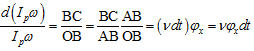 |
(5.53) |
A motor on torsional springs