It should be noted that some real part may come from the term within the square bracket of equation (11.197) as it will be clear in the following case at the boundary of stability .
The system is unstable when the real part of  is positive and it is stable when the real part of is negative. Hence, at the boundary of stability the real part of must be zero. Hence, defining the eigen value at the stability boundary as
|
(11.199) |

Hence, frequency equation (11.196) takes the following form
|
(11.200) |

On separating the real and imaginary parts, we get
|
(11.201) |

Hence, from the first equation of above, the whirl natural frequency at the stability boundary is
|
(11.202) |

and from the second equation, we have the following condition
|
(11.203) |

On substituting above condition in equation (11.197), we get
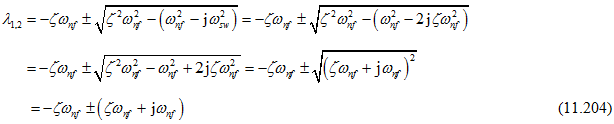
It should be noted that the real part is zero for the positive sign and for negative sign the real part is negative, which is the case at the boundary of the stability. The stability condition can be obtained as follows by the Routh-Hurwitz stability criteria.For the polynomial with complex coefficients of the following form
|
(11.205) |

For which the Routh-Hurwitz stability criteria are



Stability conditions (11.206) give
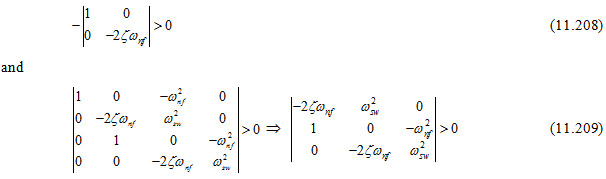
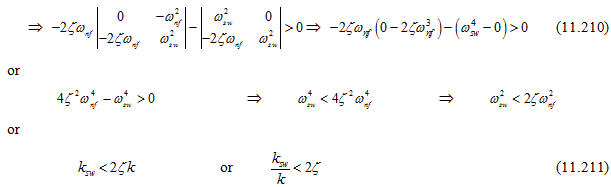
It can be seen from above equation that instability due to steam whirl can be avoided by sufficiently high damping and natural frequency. The present model does not consider the fluid-film bearing (having eight linearised dynamic coefficients), however, stability of the rotor very much depended upon bearing dynamic properties also.