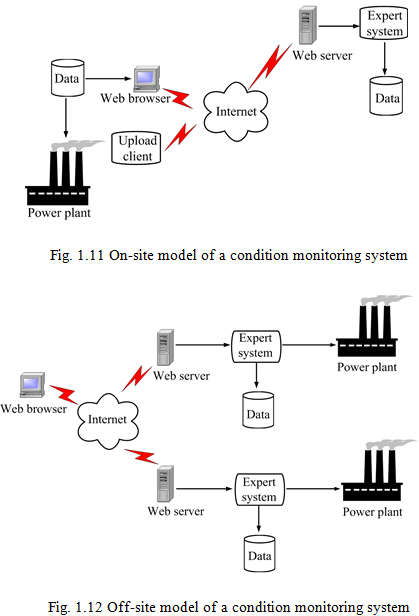
With acoustics condition monitoring, a machine running in a good condition has a stable noise spectrum. Spectrum changes when the condition changes. Identification of noise sources and comparing their spectrum with that of a stable spectrum of a machine or plant in good condition can prove to be an important tool for condition monitoring. One of the earliest documented applications of acoustic emission technology (AET) to rotating machinery monitoring was in the late 1960s. Since then, there has been an explosion in research- and application-based studies covering bearings, pumps, gearboxes, engines, and rotating structures (Robert, et al., 1993; Sato, 1990; Norton, 1989, Hall and Mba, 2004).
Concluding Remarks: Research in rotor dynamics is aimed at improving the understanding of rotor dynamic phenomena and improving the performance of rotating machinery. In most rotordynamic systems the vibratory amplitudes are sufficiently small that the linear analysis of the rotor and stator deformations is satisfactory. In rotor dynamics the structural modeling is generally adequate and most research is centered on fluid-structure interactions: bearings, seals, blade forces, squeeze-film dampers, active support elements, etc. It is here that the nonlinearities are concentrated. The equations of motion of such systems consist of a great many linear equations coupled to a small handful of nonlinear equations (Yamamoto and Ishida, 2001). Several efforts have been put on developing intelligent condition monitoring systems with advanced practicability, sensitivity, reliability and automation (Han and Song, 2003).
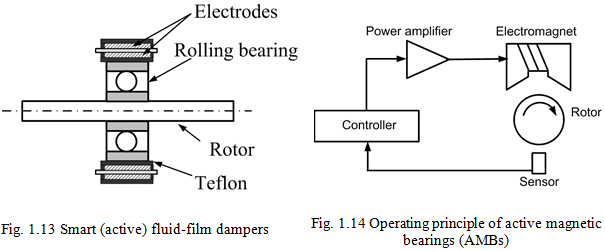
The most promising area of the research for performance improvement is the active control (Figs. 1.13 and 1.14). The latest topic in rotor dynamics is a study of magnetic bearings (a mechtronics product), which support a rotor without contacting it and active dampers (Schweitzer et al., 2003; Chiba, et al., 2005). This study has received considerable attention since Schweitzer reported his work in 1975. Now the trend is to perform the condition monitoring of rotating machineries with the help of active magnetic bearings. We are now a long way from the approaches of Jeffcott and Prohl, a journey that deserves its own history sometime. A brief bibliography in the field of rotor dynamics and the allied area is also added in references. At end it would be worth quoting from Prof. Tondl’s remark “Of course, I believe that it is not an easy matter to present a good and enough complete history of rotor dynamics because there exists an enormous number of publications in different languages.”