1.3 Development of Rotor Dynamics Analysis Tools: In rotor dynamics a remarkable amount can be explained by the dynamics of a single mass Jeffcott rotor model. This model, introduced in 1895 by Föppl, was named after Jeffcott, because in 1919 he explained the science of rotor dynamics in a graphic and illuminating way. Gradually, the Jeffcott rotor model, in its many variations, came closer to the practical needs of the rotor dynamicists of those days.
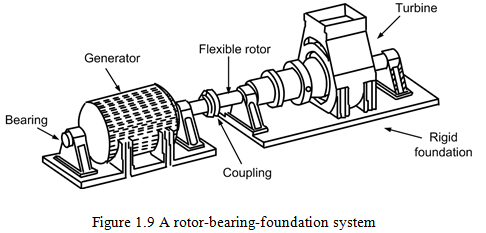
Many practical rotors, especially those being designed for steam/gas tubines for power stations (Fig. 1.9) or for aircraft gas turbines, were not suitable for a Jeffcott model. For one thing, the distinction between the disc and the shaft is blurred in the typical aircraft gas turbine (Dimentberg, 1961). In the practical design of rotating machinery, it is necessary to know accurately the natural frequencies, mode shapes and forced responses to unbalances in complex-shaped rotor systems. The technique for this was supplied by Prohl in the late 1930s and published in 1945 for the critical speed evaluation of turbine shaft. It is similar to the method published about the same time by Myklestad (1944) for the natural frequencies of aircraft wings but was developed independently. Together, Prohl's and Myklestad's work led to a broader method, now called the Transfer Matrix Method (TMM). This method is particular useful for multirotor-bearing systems and has developed rapidly since 1960s by the contribution of many researchers such as Lund et al. (1965, 1967, 1974) and Rao (1996). The TMM for rotors remains viable; indeed, it seems still to be the method of choice for most industrial rotor dynamic analyses. Another representative technique used for this purpose is the finite element method. The name finite element method first appeared in the title of a paper by Clough (1960). The first application of the finite element method to a rotor system was made by Ruhl and Booker (1972). Then Nelson and McVaugh (1976) generalised it by considering the rotary inertia, gyroscopic moment, and axial force. It was soon recognised that the large number of nodes necessary to provide accurate stress distribution created dynamic systems too large for economical calculation. Condensation of the number of degrees of freedom by division into the master and slave degrees of freedom was introduced by Guyan (1965). Other dynamic condensation techniques were described by Uhrig (1966), Friswell and Mottershead (1996), and Tiwari and Dharmaraju (2006). A related technique for the dynamic analysis of structure assembled from distinct components or substructures in the component mode synthesis introduced by Hurty (1960) and applied to rotor dynamics by Glasgow and Nelson (1980), Geradin and Kill (1984), and Crandall and Yeh (1986). Each substructure interacts only through their constraint modes. In subsequent section, a brief summary of softwares for rotor dynamics analysis is given.