1.2 Rotor Dynamics Phenomena Studies from Stodola to Lund: Developments made in rotor dynamics up to the beginning of the twentieth century are detailed in the masterpiece book written by Stodola (1924). Among other things, this book includes the dynamics of elastic shaft with discs, the dynamics of continuous rotors without considering gyroscopic moment, the secondary resonance phenomenon due to gravity effect, the balancing of rotors, and methods of determining approximate values of critical speeds of rotors with variable cross sections. He presented a graphical procedure to calculate critical speeds, which was widely used. He showed that these supercritical solutions were stabilized by Coriolis accelerations (which eventually gives gyroscopic moments). The constraint of these accelerations was the defect in Rankine's model.
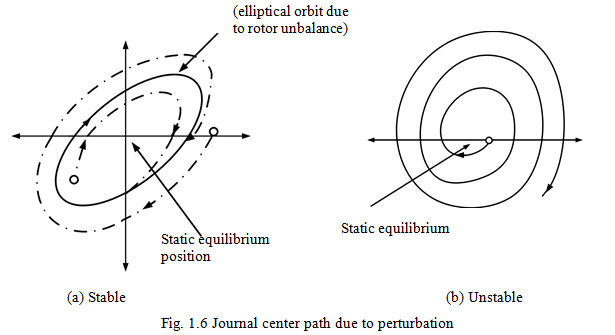
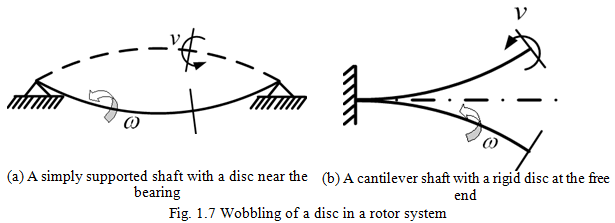
It is interesting to note that Rankine's model is a sensible one for a rotor whose stiffness in one direction is much greater than its stiffness in the quadrature (perpendicular) direction. Indeed, it is now well known that such a rotor will have regions of divergent instability (Fig. 1.6). It is less well known that Prandtl (1918) was the first to study a Jeffcott rotor with a non-circular cross-section (i.e., elastic asymmetry in the shaft). In Jeffcott's analytical model the disc did not wobble or precess (Fig. 1.7). As a result, the angular velocity vector and the angular momentum vector were collinear and no gyroscopic moments were generated. This restriction was removed by Stodola.
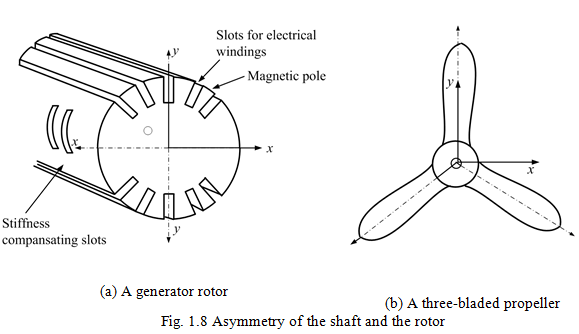
About a decade latter, the study of asymmetrical shaft systems and asymmetrical rotor systems began. The former are systems with a directional in the shaft stiffness (Fig. 1.8a) and the latter are those with a directional difference in rotor inertia (Fig. 1.8b). Two-pole generator rotors and propeller rotors are examples of such systems. As these directional differences rotate with the shaft, terms with time-varying coefficients appear in the governing equations. These systems therefore fall into the category of parametrically excited systems (in which vibrations depend on the motion itself, howevre, it may occur in a linear or a nonlinear system). The most characteristic property of asymmetrical system is the appearance of unstable vibrations in some rotational speed ranges. In 1933 Smith obtained a pioneer work in the form of simple formulas that predicted the threshold spin speed for the super-critical instability varied with bearing stiffness and with the ratio of external to internal viscous damping. To quote from Smith's paper " . . . (the) increase of dissymmetry of the bearing stiffness and in the intensity of (external) damping relative to (internal) damping raises the (threshold) speed . . . and [this threshold) speed is always higher than either critical speed." The formula for damping was obtained independently by Crandall (1961) some 30 years later.