Now 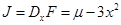 ................................................................................................(4.2.10)
So, for the trivial branch  and the eigenvalue is
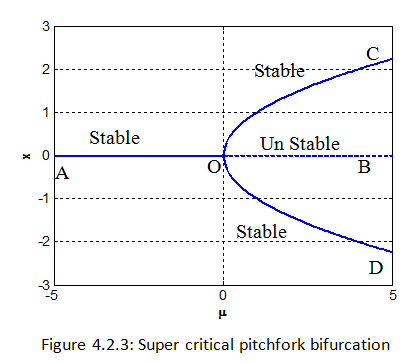
  . Hence, the branch AO for which the eigenvalue is negative, is stable and the branch OB which has a positive eigenvalue (
  ) is unstable.
Similarly for the nontrivial solution shown by the curve COD, the eigenvalue is
 ........................................................................................ (4.2.11)
As for this branch, the eigenvalue is always negative and so the branch is stable.
It should be noted that before point ‘O', the system has only stable trivial state solution and after this point, the system has 3 branches, out of which the trivial state is unstable and non-trivial state is stable. So, there is a change in the number of solution and also, change of stability of the system at point O. Hence this is a bifurcation point and this bifurcation point is known as super-critical pitchfork bifurcation point.
Here, it can be shown that
 ........................................................................................(4.2.12)
At the origin which is a bifurcation point  . Hence the rank is less than 1.
Now by considering  , one can find the equilibrium points at x=0 and
  . Hence, the system has a trivial solution for all values μ and nontrivial solution only for μ<0 as shown in Figure 4.2.4 (a). In this case, the eigenvalue
  . Hence, for trivial state, the branch AO is stable and branch OB is unstable. Similarly for nontrivial state
  and hence unstable.