At a saddle-node point  does not belong to the range of
  and for pitchfork and transcritical bifurcation point belongs to the range of . It may be noted that the range of an
  matrix A consists of all vectors AZ where
  . Hence
  has a rank of n at saddle node bifurcation point and rank of ( n -1) at other static bifurcation point.
In the state control space all of the branches of fixed points that meet at a saddle-node bifurcation point have the same tangent. For pitchfork and transcritical bifurcation points tangents are not same for all the branches meeting at the bifurcation points.
Saddle-node Bifurcation
The generic form of saddle-node bifurcation is  . When a scalar control parameter μ is varied, in the
  plane, a static bifurcation occurs when the following conditions are satisfied.
1  i.e.,
i.e.,  or,
or,  .........................................................(4.2.2)
2. Now the Jacobian matrix 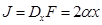 . At the bifurcation point it can be written as
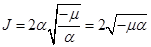 ..................................................................................................(4.2.3)
Hence, the eigenvalue  .................................................................................(4.2.4)
Taking  ........................................................................(4.2.5)
Figure 4.2.2(a) shows the variation of equilibrium point  with control parameter μ for the system
  . In this case the equilibrium points are
  and the eigenvalue is -2x which change its sign at
  For positive value of the response is stable and for negative value of the response is unstable. From the figure it is clear that the bifurcation point is at μ=0 and it is a saddle-node bifurcation as the two branches meeting at μ=0 have same tangent. Also now constructing the matrix one can write
=  , So does not belongs to range of . Rank of this matrix is 1. So the origin is a saddle-node bifurcation point.