Bifurcation analysis of fixed point response
In nonlinear systems, while plotting the frequency response curves of the system by changing the control parameters, one may encounter the change of stability or change in the number of equilibrium points. These points corresponding to which the number or nature of the equilibrium point changes, are known as bifurcation points. For fixed point response, they may be divided into static or dynamic bifurcation points depending on the nature of the eigenvalues of the system. If the eigenvalues are plotted in a complex plane with their real and imaginary parts (as shown in fig 4.2.1) along X and Y directions, a static bifurcation occurs, if with change in the control parameter, an eigenvalue of the Jacobian matrix crosses the origin of the complex plane. In case of dynamic bifurcation, a pair of complex conjugate eigenvalues crosses the imaginary axis with change in control parameter of the system. Hence, in this case the resulting solution is stable or unstable periodic type.
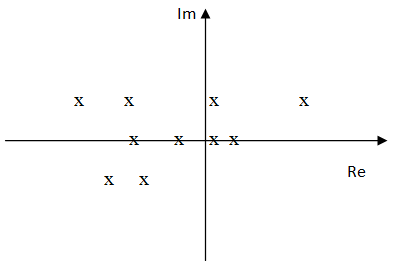
Fig. 4.2.1: Variation of eigenvalues in a complex plane
Static Bifurcation
For a system  , following two conditions to be satisfied at the static bifurcation point.
1.  ............................................................................................................ (4.2.1)
2. The Jacobian matrix  has a zero eigenvalue while all of its other eigenvalues have non zero real parts at
  . Hence the point is nonhyperbolic.
There are mainly three different types of static bifurcation points viz., saddle-node, pitch-fork and transcritical bifurcation.
One can distinguish saddle-node bifurcation from other bifurcation point by finding  which is a
  vector of first partial derivatives of the components of F with respect to the control parameter μ and then by constructing a matrix
  .
.