Equation (2.3.8) is partial differential equation of motion and (2.3.9) are the boundary conditions.
To develop different nonlinear equations of motion for string systems, one may refer the following papers on nonlinear vibration of strings.
- 1. G.S.S. Murthy, B.S. Ramakrishna, Non-linear character of resonance in stretched strings, J. Acoust. Soc. Am., 38 (1965), p. 461
2. J.W. Miles, Stability of forced oscillations of a vibrating string, J. Acoust. Soc. Am., 38 (1965), p. 855
3. G.V. Anand, Non-linear resonance in stretched strings with viscous damping, J. Acoust. Soc. Am., 40 (1966), p. 1517.
4.- E.W. Lee, Non-linear forced vibration of a stretched string, Br. J. Appl. Phys., 8 (1957), p. 411
5. - D.W. Oplinger, Frequency response of a non-linear stretched string, J. Acoust. Soc. Am., 32 (1960), p. 1529
6. - G.F. Carrier, On the non-linear vibration problem of the elastic string, Q. Appl. Math., 3 (1945), p. 157
Exercise Problems
Prob. 2.3.1. Derive the equation of motion of a base excited cantilever with an attached mass at arbitrary position as shown in Fig. 2.3.2. (Ref: Zavodney and Nayfeh(1989),
Prob.2.3.2: Derive the equation of motion of a dynamic vibration absorber as shown in Figure 2.3.3.
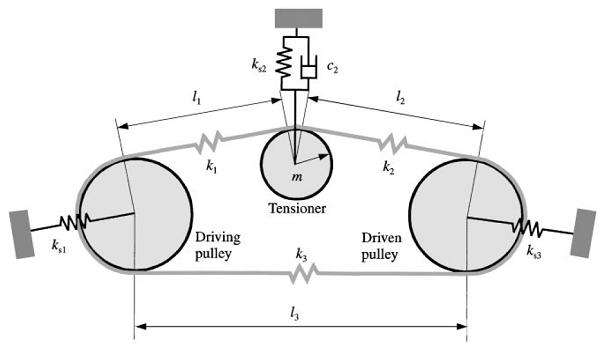
Prob. 2.3.3: Derive the equation motion of the moving belt system shown in Fig. 2.3.4 [C.A. Jones, P. Reynolds, A. Pavic, Vibrational power flow in the moving belt passing through a tensioner, Journal of Sound and Vibration , Volume 330, Issue 8, 2011, Pages 1531-156 ]
Answer: 