Solution:
Here, the Cartesian manipulator with payload is modeled as a roller-supported Euler–Bernoulli beam with a tip mass. The thickness ( h ) of the beam is considered to be very small in comparison to the length of the beam ( L ). Hence, the effects of the shear deformation and rotary inertia of the beam are neglected. The transverse vibration (v) of the beam is assumed to be purely planar. The torsional mode of the beam is neglected in this analysis. Payload mass is considered as a point mass which is symmetrically placed with respect to the centerline of the beam. The harmonically varying tip load is acting always in the tangential direction of the elastic line and the amplitude of the axial force is taken less than the critical buckling load.
The governing equation of motion of the present system is derived using d' Alembert's principle. Considering a small element at a distance s from the roller-supported end (Fig.2 3.1) along the elastic line of the beam, the bending moment M(s) of the beam can be expressed as:
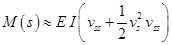 ............................................................................................ (2.3.1)
Here, v is the transverse displacement of the beam.  is the first derivative with respect to s along the beam. Following Zavodney and Nayfeh (1989), and Cuvalci (1996, 2000), one may write the inextensibility condition of the beam in terms of the longitudinal displacement
  and the transverse displacement
  as:
as:
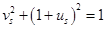 . ..............or,
 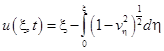 . .............................................(2.3.2)
Here, ξ, η are the integration variables. Considering the inertia forces per unit length of the beam  and
and  in longitudinal and transverse directions, respectively and inertia forces of the tip mass in longitudinal and transverse directions as
 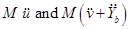 , respectively, one may write equation (2.3.1) as follows:
 .......................................................................................... (2.3.3)