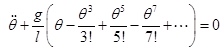
 ...............................................................................(2.1.9)
Or, 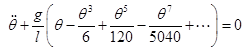 ..................................................................(2.1.10)
It may be noted that for higher power of θ, the coefficient become very small and hence the higher order terms can be neglected.
Keeping up to 5th order, the equation can be written as
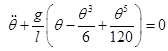 ........................................................................................... (2.1.11)
which is a form of Duffing equation with cubic and quintic nonlinearities.
One may derive the same equation using the fact that the moment of a force about a fixed point  is equal to the time rate of change of the angular momentum about poin
  . In mathematical form it can be written as
  . Refereeing to Figure 2.1.2(b)
 ..................................................................................................................(2.1.12)
Or,  .............................................................(2.1.13)
Now, 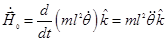 ..................................................................................(2.1.14)
Or,  ...........................................................................................(2.1.15)
Or ,  ............................................................................................ (2.1.16)
Or,  ...................................................................................................... (2.1.17)
Keeping up to cubic nonlinearity Eq. (2.1.17) can be written as
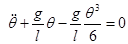 ..................................................................................................... (2.1.18)
Taking the length of the pendulum 1 m and acceleration due to gravity as 10 m/s2 the equation of motion can be written as
 ..............................................................................................(2.1.19)
It may be noted that the coefficient for the cubic order term is very less than that of the linear term. A MatLab code is given below to obtain the variation of restoring force with θ which will give an idea regarding the approximation one has to take while writing the equation of motion.
The equation is similar to a Duffing equations with soft type cubic nonlinearity