Equation (2.1.4) can also be written as,  where
where  is the inertia force. This is d' Alembert's principle which states that a moving body can be brought to equilibrium by adding inertia force
  to the system. In magnitude this inertia force is equal to the product of mass and acceleration and takes place in a direction opposite to that of acceleration. Now two examples are given below to show the application of Newton's 2nd law or d' Alembert's principle to derive the non linear equation of motion of some systems.
Example 2.1.1 : Use Newton's 2nd law to derive equation of motion of a simple pendulum
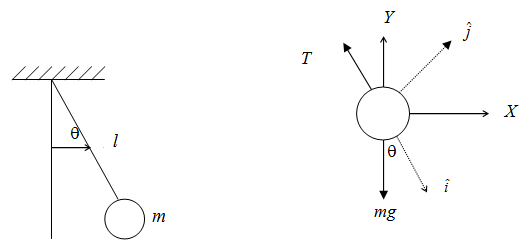
Figure 2.1. 2: (a) simple pendulum (b) Free body diagram
Solution: Figure 2.1.2 (a) shows a simple pendulum of length l and mass m and Figure 2.1.1(b) shows the free body diagram of the system. The acceleration of the pendulum can be given by  . From the free body diagram total external force acting on the mass is given by
 ..............................................................(2.1.5)
Now using Newton's second law's of motion i.e., 

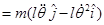 ......................................................(2.1.6)
Now equating the real and imaginary parts one can get the equation of motion and the expression for the tension. The equation of motion is given by
 ........................................................................... (2.1.7)
and the expression for tension can be given by
 .....................................................................(2.1.8)
Taking 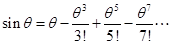 , the nonlinear equation of motion of the system up to 7th order nonlinear term can be given by
..........................................................................