Force and Momentum based Approach
In this approach one uses Newton's second law of motion or d'Alembert's principle to derive the equation of motion. This is a vector based approach in which first one has to draw the free body diagrams of the system and then write the force and moment equilibrium equations by considering the inertia force and inertia moment of the system.
According to Newton's second law when a particle is acted upon by a force it moves so that the force vector is equal to the time rate of change of the linear momentum vector.
Consider a body of mass m positioned at a distance r from the origin of the coordinate system XYZ as shown in Figure 2.1.1 is acted upon by a force F. According to Newton's 2nd Law, if the body has a linear velocity v, linear momentum vector p=mv , the external force is given by the following equation.

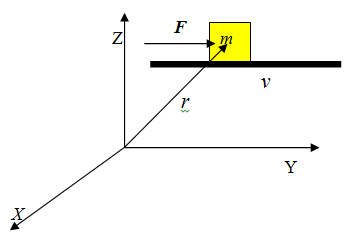
Figure 2.1.1: A body moving in XYZ plane under the action of a force F
Considering  to be the absolute position vector of the particle in an inertial frame, the absolute velocity vector can be given by
 ..................................................................................................................... (2.1.2)
the absolute acceleration vector is given by
 ..................................................................................................................(2.1.3)
Assuming mass to be time invariant,
Hence 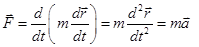 .......................................................................(2.1.4)