2.Angular Perspective or 2-point perspective
One edge of the object is kept parallel to the PPP., as shown by line AE of figure 3. The two faces, ABFE and ADHE, sharing the edge AE are inclined to the PPP. Each edges perpendicular to the edge AE and parallel to PPP will converge to two vanishing points on HL on either side of the observer. To obtain the vanishing points, draw lines parallel to edge ab and ad and passing through the station point. The intersection of these line with PPP are respectively v1 and v2. From v1 and v2, drop vertical projectors to HL to obtain the vanishing points V1 and V2 respectively. Since edge AE is in PPP, the front view of this edge (AE) will be its true length. Draw lines from V1 and V2 and passing through points E and A in the Front view . To obtain the perspective for the edges BF, CG and DH, join the respective points in the top view with the station point s. label the points where these rays pierces the PPP as a1, b1, c1, d1, e1, f1 and g1. Draw vertical projectors from d1 and h1 to intersect the lines joining V1 to A and E in the front view. Similarly points B and F are obtained by drawing the vertical projectors from b1 and f1 and intersecting the lines joining V2 with A and B in the front view. Points C and G are obtained by drawing the vertical projectors from c1 and g1 in the top view and the respective intersection of the lines joining V2 to D and H (or lines joining V1 to points B and F.
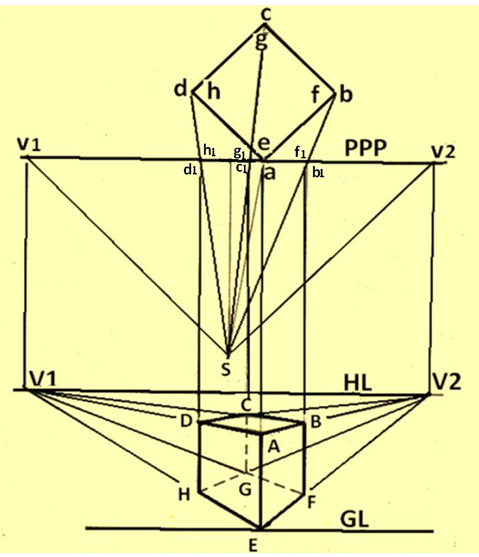
Figure 3. Angular projection perspective view of a rectangular prism .
Line of heights
When a line is in the picture plane, it is seen in its true length in perspective. The top view and Front view of a rectangle ABCD, shown in figure 4, whose surface is vertical and inclined to the picture plane is shown as abcd and ABCD. DC is on the ground plane and edge AD is in the picture plane. In the perspective view , edge A’D’ is equal to the true length AD. Edge B’C’ is shorter than BC. The length B’C’ is derived from A’D’ and V.
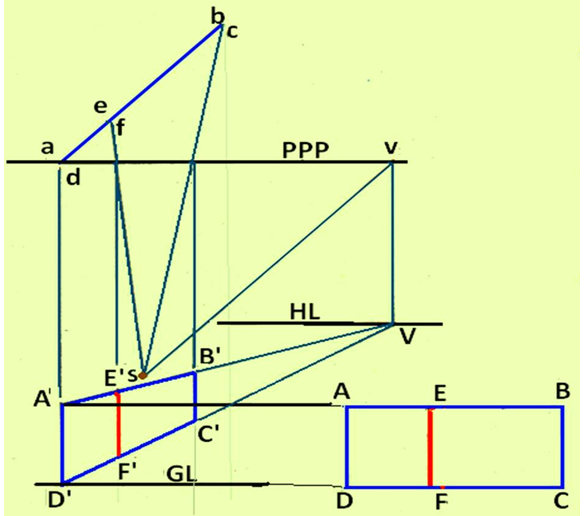
Figure 4. Illustrating the significance of line of height