Perspective projection -2
Drawing the perspective by Vanishing point method
Vanishing points are imaginary points at infinite distance away from the station point. This is the point at which the visual rays from the station point to the infinitely distant vanishing point pierces the Picture plane (PPP).
Vanishing point of the line AB (line ab in the top view), lying on the ground and inclined at an angle to the picture plane can be obtained by drawing a line parallel to its top view and passing through the station point s. The intersection of this line with the PPP, (i.e. v) is the top view of the vanishing point. The front view V is obtained by projecting point v to the Horizon line(HL) as shown in figure 1.
- Perspective of all horizontal lines, when produced, pass through their respective vanishing points on the horizon line.
- Perspective of all horizontal line which are parallel to each other converge to a vanishing point on the horizon line.
- Perspectives of all lines perpendicular to the picture plane converge to the centre of vision on the horizon line.
- Perspective of lines parallel to the picture plane will have no vanishing points since these are parallel to the original lines and remain horizontal.
- Perspective of vertical lines are vertical.
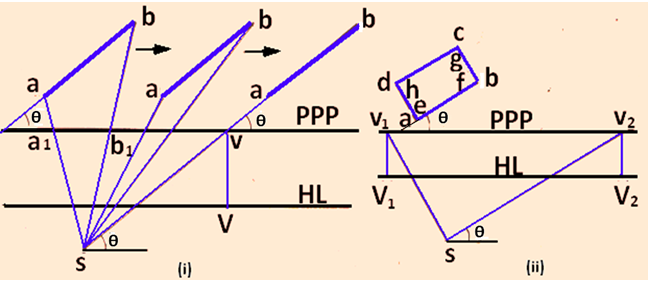
Figure 1. Illustration of vanishing point of a line.
The method of drawing perspective view by vanishing point method is discussed below:
- Parallel Perspective or 1-point perspective
Here one face of the object is kept parallel to and in the PPP as shown in figure 2. Since this face is in the PPP, the edges in the front view will be true dimensions. The edges perpendicular to this face appears to be converging to a VP. Draw visual rays from the station points to the object points in both TP and FV. Draw vertical projectors from the piercing points in the top view to meet the corresponding visual rays in the front view.
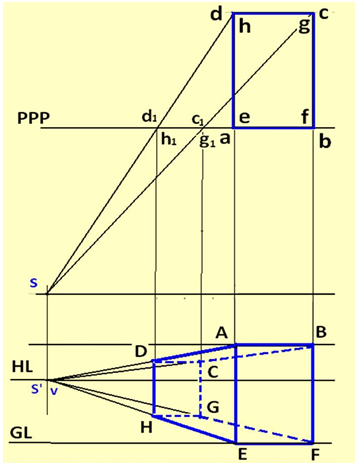
Figure 2. 1-point perspective view of a rectangular prism with one face in PPP.