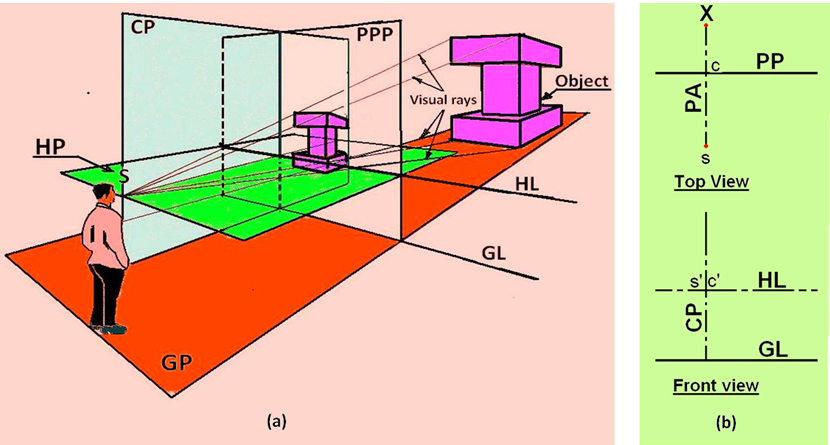
Figure 2. Shows (a) various elements used in perspective projection and (b) the top view and front view showing the station point, GL, HL, PP etc.
Perspective Projection Methods
Two commonly used methods are
- Visual Ray method
- Vanishing Point method
Common types of perspective Projection
- Parallel Perspective or 1-point perspective : Here one face of the object is kept parallel to the PPP. The edges perpendicular to this face appears to be converging to a VP.
- Angular Perspective or 2-point perspective: One edge of the object is kept parallel to the PPP. Each edges perpendicular to them converges to one of the two VPs.
- Oblique Perspective or 3-point Perspective: Neither an edge nor a face of the object is kept parallel to PPP. Ach edges is seen to be converging to one of the three VPs.
To draw the perspective , the following information is required:
- Top View and Front View (or Side View of) the object. Since the PPP lies between the observer and the object, third angle projection technique is used.
- Orientation and location of the object w.r.t the PPP.
- location of station point S w.r.t to PPP and GL .
Normal practice for location of S is at the normal to the eye level for big objects like buildings and for small objects s is located at such a height that all the three dimensions of the objects are almost visible.