Perspective projections
When an object is viewed from different directions and at different distances, the appearance of the object will be different. Such view is called perspective view. Perspective projections mimic what the human eyes see. This is evident from the two photographs shown in figure 1. In the first photograph, it appears that the height of the building near to the observer is taller than the height of the building farther than the observer though the heights of all these buildings are same. Similarly the width of the road appears to be shortened for the region which is away from the observer, though the width of the road is same along the length. It appears that the two sides of the road may meet at some far away distance from the observer. This is a simple representation of the perspective view.
Perspective views are not important for a manufacturing unit. They are used to communicate information to non technical persons. Hence it is very important for commercial purposes. In perspective projection, all lines of sight start at a single point. Distance from the observer to the object is finite and the object is viewed from a single point – projectors are not parallel.
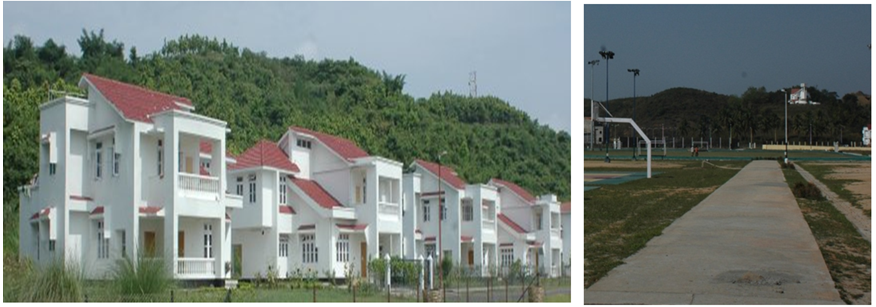
Figure 1. Photograph of (a) buildings and (b) a road as observed by the human eye or a camera
Before discussing further, it is important to be familiar with the terminology used for the perspective projection
Terminology
Assume an observer viewing the Object as shown in figure 2. The line of sight is diverging from the observer’s eyes and falling on the object. Consider the rays meeting the edges of the object. The rays are intersecting the perspective picture plane (PPP) which is between the observer and the object, . Referring to figure 2, the various elements used in perspective projection are defined below.
Perspective Picture plane (PPP): It is a vertical projection plane used to obtain the object’s Perspective.
Station point (s) : It is a point at which the eyes of the observer are located. S and S’ indicated respectively the TV and FV of S.
Visual rays: These are the rays of sight emerging from S and ending at the object’s corners.
Piercing points: This is the intersection point of visual rays with the PPP.
Horizon plane (HP): A horizontal plane passing through S (observer’s eyes).
Horizon line (HL) : The line obtained by the intersection of HP on PPP.
Perpendicular axis (PA): it is the line drawn through the station point and perpendicular to the picture plane. It is also called axis of vision or line of sight.
Ground plane (GP): The real ground or the imaginary plane parallel to the ground on which the object is assumed to be resting.
Central plane (CP) : it is a vertical plane passing through S and perpendicular to PPP
Vanishing point (VP): These are points at which the edges of the object appear to be converging . This point is seen at eye level, ie. on HP.