3.Development of transition pieces joining two curved surfaces
The development of a transition piece of circle to circle but with different diameters is shown in figure 4, where the axes of the two circular sections are offset by 15 mm. first draw the TV and FV of conical reducing piece. Divide the two circles in to twelve equal parts. Connect point 1-a,2-b, 3-c, etc in the TV and 1’-a’, 2’-b’,etc in the FV. These lines are called radial lines. The radial lines divide the lateral surface in to a number of equal quadrilaterals. Their diagonals are connected (dashed lines) forming a number of triangles. The true length diagram are drawn separately for radial and diagonal lines and is shown in figure 4. The development is drawn for half of the transition piece by triangulation method and using the true length of the radial lines and diagonal lines.
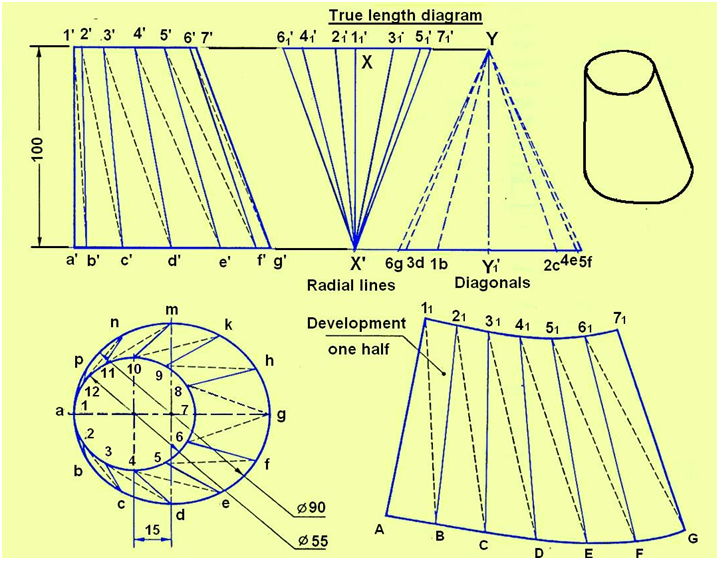
Figure 4. Development Transition pieces joining two circular sections.