Development of Transition pieces
In industries when different pipes or vessels having different shapes and sizes are to be joined. These are facilitated by using special sections called transition pieces. Transition pieces are the sheet metal objects used for connecting pipes or openings either of different shapes of cross sections or of same cross sections but not arranged in identical positions. In majority of the cases, the transition pieces are composed of plane surfaces and conical shapes. The conical surfaces are developed by triangulation technique. These are highlighted in the subsequent paragraphs.
Triangulation development
The triangulation development is employed to obtain the development of transition pieces. These consists of the following:
- Transition pieces joining a curved cross section to a non curved cross section (e,g, Square to round, hexagon to round , square to ellipse, etc.)
- Joining two non-curved cross sections (e.g. square to hexagon, square to rectangle, square to square in un-identical positions)
- Joining only two curve sections (e.g. Circle to oval, circle to an ellipse, etc)
In this method, the lateral surfaces of the transition pieces are divided in to a number of triangles. By finding the true lengths of the sides of each triangle, the development is drawn by laying each one of the triangles in their true shapes adjoining each other.
Transition pieces joining curved to Non-curved cross sections
Figure 1 shows the top view and pictorial view of two transition pieces: (a) the pentagonal base joined to a circular top and (b) circular base connected to a square top. The lateral surface of the transition piece must be divided in to curved and non-curved triangles as shown in figure 1. . Divide the curved cross section in to a number of equal parts equal to the number of sides of non-curved cross-section. Division points on the curved cross section are obtained by drawing bisectors of each side of the non-curved cross section. The division points thus obtained when connected to the ends of the respective sides of the non-curved cross-section produces plane triangles. In between two plane triangles there lies a curved triangle. After dividing in to a number of triangles, the development is drawn by triangulation method.
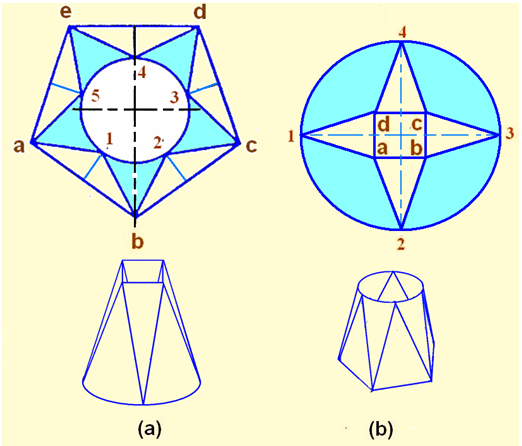
Figure 1. Shows the top view and pictorial vies of two transition pieces.