- Development of a transition piece from square to circular section
Figure 2 shows the development of a transition piece connecting a circular top section with a square bottom section. Divide the circumference of the circle in to four equal parts by drawing perpendicular bisectors of the base edge (square edge) in the top view. Join 1-a, a-5, 5-b, b-9, 9-c, c-13, 13-d, d-1. The transition piece now consists of 4 plane and 4 curved triangles.1da, 5ab, 9bc, and 13cd are plane triangles and 1a5, 5b9, 9c13 and 13d1 are curved triangles.
Since the transition piece is symmetrical about the horizontal axis pq in the top view, the development is drawn only for one half of the transition piece. The front semicircle in the top view is divided in to eight equal parts 1,2,3,4, etc. Connect points 1,2,3,4 and 5 to point a. Project points 1,2,3,etc to the front view to 1’,2’,3’. etc. Connect 1’, 2’, 3’ etc to a’ and 5’, 6’, 7’, 8’ 9’ to b’. The development of the one half of the transition piece is drawn from the true length diagram. The procedure for drawing the true length diagram is explained below.
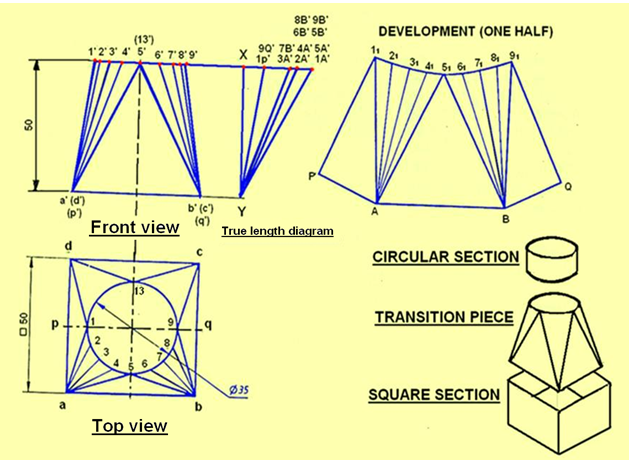
Figure 2. Development of a transition piece with circular top and square bottom.
True length diagram and development
- Draw vertical line XY.
- The first triangle to be drawn is 1pa (shown in the top view)
- The true length of sides 1p and 1a are found from the true length diagram. To obtain true length of sides 1p and 1a, step off the distances 1p and 1a on the horizontal drawn through X to get the point 1P’ and 1A’. Connect these two points to Y. The length Y-1P’ and Y-1A’ are the true lengths of the sides 1p and 1a respectively.
- 11P = Y-1P’. Draw a line with center 11 and radius Y-1A’. With P as center and radius pa, as measured from the top view, draw an arc to cut to meet at A.
- With A as center and radius equal to true length of the line 2a (i.e Y-2A’), draw an arc.
- With 11 as center and radius equal to 1-2 (T.V), draw another arc intersecting the pervious arc at 21.
- Similarly determine the points 31, 41 and 51.
- A -11-21-31- 41- 51 is the development of the curved triangle 1-a-5.
- A-51-B is the true length of the plain triangle a-5-b.
- Similar procedure is repeated for the other three curved triangles and plain triangles.