Classifications of developments
1. Parallel-line development: They are made from common solids that are composed of parallel lateral edges or elements. e.g. Prisms and cylinders as shown in figure 5. The cylinder is positioned such that one element lies on the development plane. The cylinder is then unrolled until it is flat on the development plane. The base and top of the cylinder are circles, with a circumference equal to the length of the development. All elements of the cylinder are parallel and are perpendicular to the base and the top. When cylinders are developed, all elements are parallel and any perpendicular section appears as a stretch-out line that is perpendicular to the elements.
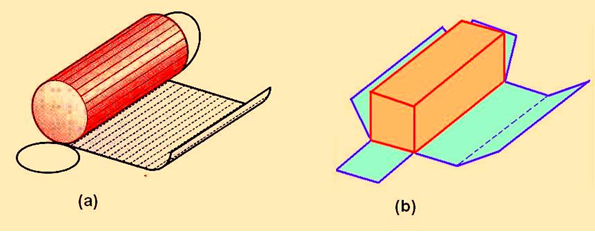
Figure 5 shows the parallel line development technique for (a) cylinder and (b) rectangular block.
2. Radial-line development
Radial-line developments are made from figures such as cones and pyramids. In the development, all the elements of the figure become radial lines that have the vertex as their origin. Figure 6 shows the radial development for a cone. The cone is positioned such that one element lies on the development plane. The cone is then unrolled until it is flat on the development plane. One end of all the elements is at the vertex of the cone. The other ends describe a curved line. The base of the cone is a circle, with a circumference equal to the length of the curved line.
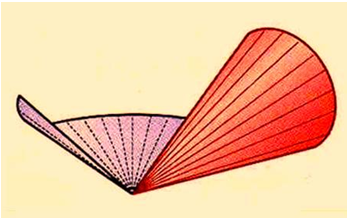
Figure 6 shows the radial development method for a cone.