Differentiating Eq. (2.68), we get
|
(2.69) |
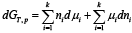
(at constant temperature and pressure)
When temperature and pressure changes,
|
(2.70) |
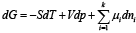
Comparing Eq. (2.69) and Eq. (2.70), we get,
|
(2.71) |

or,
|
(2.72) |
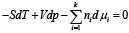
Eq. (2.72) is known as Gibbs-Duhem Equation. It represents simultaneous changes of T, p and μ.
Now,
|
(2.73) |

For a phase consisting of single constituent,
G = μn |
|
G = μn |
(2.74) |
Hence, chemical potential is the molar Gibbs function and is a function of T and p. For a single phase, μi is a function of T, p and mole fraction xi.