Let us consider a system containing a mixture of substances 1,2, 3,…….k. If some quantities of a substance are added to the system, the energy of the system will increase. Thus for a system with variable composition, the internal energy depends not only on S and V, but also on the number of moles (or mass) of various constituents of the system.
U = U(S,V,n1,n2,..............,nk) |
(2.41) |
where, n1,n2,n3,..............,nk are the number of moles of substances 1,2,3,……k.
The composition may change not only due to addition or subtraction, bur also due to chemical reaction and inter phase mass transfer.
For a small change in U, assuming the function to be continuous,
|
(2.42) |
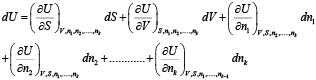
|
(2.43) |

where the subscript i = any substance
j = other substance except the one whose number
of moles is changing.
If composition does not change,
dU = TdS - pdV |
(2.44) |
|
(2.45) |

and
|
(2.46) |

|
(2.47) |
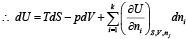
Eq. (2.47) can be written as
|
(2.48) |
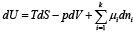
where  is the molar chemical potential. It signifies the change in internal energy per unit mole of component i when S, V and number of moles of all other components are constant. The chemical potential drives mass (or species) similar to the thermal potential that drives heat transfer from higher to lower temperature.