Throttling Devices
A throttling device is the generic name of any device or process that simply dissipates pressure energy by irreversibly converting it into thermal energy. Unlike nozzles and diffusers, throttling devices provide no form of useful energy recovery. They merely convert pressure energy into thermal energy through dissipative viscous flow processes. A throttle need not have same inlet and outlet flow velocities, and, therefore, it may have a significant specific kinetic energy changes across it. Throttles may or may not be insulated, but they are usually such small devices and have such high flow rates that the residence time of the fluid in them is too short for significant heat transport of energy to occur. Consequently, a throttling device is commonly taken to be adiabatic regardless of whether it is actually insulated or not.
Joule Kelvin (Joule-Thompson) Effect
The throttling phenomenon, also known as Joule – Kelvin /Joule –Thompson effect, may be demonstrated by considering a steady-state, steady flow (SSSF) process across a restriction, with a resulting drop in pressure. The restriction can be a porous plug, an orifice plate, a butterfly valve, any type of flow or pressure control valve. Even a geometry like sudden contraction or sudden expansion may give the desired effect [Fig. 1.19].
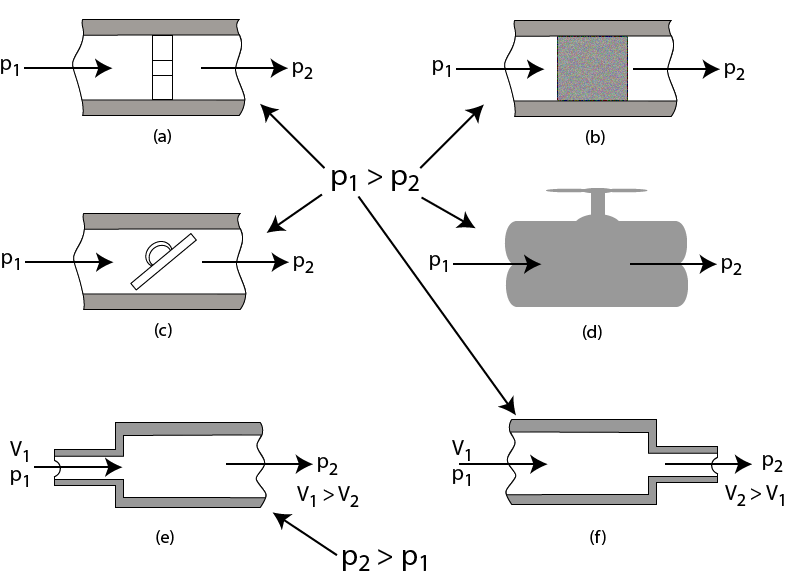
Fig: 1.19 (a) Orifice plate, (b) Porous plug, (Butterfly/throttle Valve ), (d) Any type of flow or pressure control valve (e) sudden expansion, (f) Sudden contraction