Module 9 : Robot Dynamics & controls
Lecture 33 : Actuator dynamics and PD, PID control for robots.
Now the question is how to bring the block to rest at BB'?
  One may easily say that introduction of damping is needed to bring the system to rest. Now if we want to answer this question from Control point of view we will say that introduction of Derivative Control alongwith proportional control will do the desired job.
   
  PROPORTIONAL & DERIVATIVE CONTROL ACTION (PD CONTROL):-
  Control Stategy for PD control is
 
  Now consider a spring mass system . What will happen to its behavior when viscous damper is introduced in the system.
 
Figure 33.13 Equivalent Spring-Mass-Damper system
  Now the differential equation of motion for this system is
 

Damping force = Damping Coefficient * Rel. Velocity (Between Piston & Cylinder) is equivalent to Damping Coefficient

  This damping force will always resist motion of block. With the introduction of Damper in system, block will perform oscillations of decreasing amplitude & finally comes to rest ,but at which position it comes to rest? Whether it comes to rest at desired one or not?
  Answer is it will come to rest at a position slightly different from the desired one.The difference in this position & desired one is known as Steady State error. It is inherently there. Explaination is here comes one situation for which the amplitude of vibration is so small that restoring spring force will be very small & if it tries to move the block it cannot do it. Because as soon as block starts moving Damping force comes into picture which will be very high as compared to the spring force( which is function of deflection). Hence the block will come to rest at a position other than BB'. So there is inherently steady state error whenever we will use Proportional & Derivative Control action. But this steady state error is not permitted in certain applications.
  PROPORTIONAL DERIVATIVE & INTEGRAL CONTROL ACTION (PID CONTROL):-
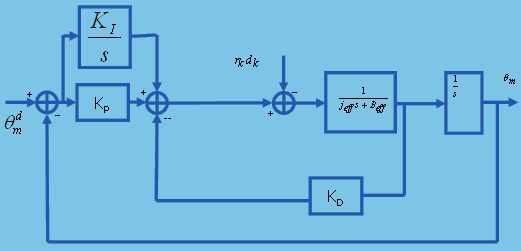
  To remove steady state error in PD control , PID control is incorporated. Additional element used is Integrator.
  Control Strategy:
 

= proportional gain

=derivative gain

=Integrator gain.

 
Figure 33.14 PID Control
 

Integrator action can be physically interpreted in following manner

It is equivalent to a pneumatic circuit containing flow control valve , 4/2 directional control valve & double acting cylinder. Difference in position or error will control the flow of air to cylinder. Air is compressible. When there is slight difference in reqd. and actual position there will be very small flow of air to the cylinder. As time elapses being no movement of piston pressure of air in cylinder starts increasing (this can be considered as integration over time) & one stage will come where the pressure is such that force exerted due to it on block + spring force will overcome the damping force reqd. to move the block with certain velocity. Hence there will be movement of block which will lead to the reduction of position error. But the reduction in error reduces spring force . So more time will be required for next integrator action than previous one. In this way the steady state error is eliminated. But certain time is required for this action to take place.