|
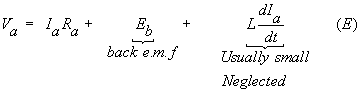
This voltage will tend to oppose the current flow in the conductor. This we have to take into account. So |
| |
|
| |
Elimination of current I
from (C) using(D) & (E) |
| |
|
| |
Rearranging and introducing subscripts corresponding to k th joint
|
| |
 |
| |
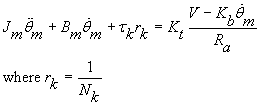
Now we combine robot and actuator dynamics to get |
| |
But robot dynamical equation is |
| |
 Vector Matrix equation Vector Matrix equation |
| |
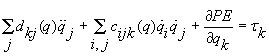 equation corresponding to one link equation corresponding to one link |
| |
where k=1,2,.....,n. |
| |
but  Actuator Dynamics equation Actuator Dynamics equation |
| |
We get by substitution of  into it
 |
| |
|
| |
here generalised co-ordinate is expressed as  where where |
| |
|
| |
 |
| |
Normally each axis of the manipulator is controlled separately, we will separate the coupling effects due to motion of other links& we will ignore them or treat them as a disturbance.Hence the terms representing Coupled inertias, Coriolis & Centripetal terms are separated & grouped under name dK.While developing control algorithm we will treat this term as disturbance & controller will be designed such that the effects of this disturbance on plant (Robot manipulator) output are reduced. If this is accomplished, then the plant(Robot Manipulator) is said to "reject" the disturbances.This kind of control is known as Independent joint control in which each axis of manipulator is controlled as a single input/single output system. |
| |
|
| |
This is a linear diffferential equaiton of system alongwith nonlinear disturbance . In this way Robot and actuator dynamics equation reduced to linear form with nonlinear terms grouped as a disturbance. Note that . In this way Robot and actuator dynamics equation reduced to linear form with nonlinear terms grouped as a disturbance. Note that  is assumed to be constant but it is function of generalised co-ordinate. Hence it is not constant.We will use these linear form of equations to develop simple control algorithms is assumed to be constant but it is function of generalised co-ordinate. Hence it is not constant.We will use these linear form of equations to develop simple control algorithms |
| |
|