Lecture 33 : Actuator dynamics and PD, PID control for robots.
Actuator Dynamics
We have obtained the set of differential equations describing the dynamics of n degree of freedom Robot manipulator as
In this equation is the generalised force or torque acting at the joint which is produced by an actuator which may be electric, pneumatic or hydraulic. Study of Robot dynamics gives us force or torque requirement imposed by Robot manipulator which actuator have to supply. So it is necessary to study the actuator dynamics alongwith Robot dynamics as Control Problem of Robot manipulator lastly gets converted into Control of Actuator.
Figure 33.1 SERVO MOTOR
Normally there is a separate actuator for each joint. Actuators may be Electric, Hydraulic or Pneumatic. We will study Dynamics of Servo motors only as these are increasingly common for use in present-day Robots. Electric Motors are having linear equations of Dynamics while Hydraulic actuators are having nonlinear equations of Dynamics. Now we will see types of Electrical Servo Motor.
Types of Servo-Motors
DC Brush and brushless type.
AC servomotors.
Motor Dynamics:
We will study motor dynamics in two steps. In first step we will study mechanical part only & in second we will study electrical part.Then we will combine mechanical & electrical part. This will be then coupled with Robot Dynamics.
Figure 33.2 ARMATURE FREE BODY DIAGRAM
First we will see mechanical part.
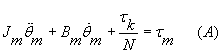
Let = torque supplied by motor =Damping coefficient of motor. =Load coming on motor due to Robot link. Torque supplied by motor will be used to overcome against load torque (due to robot manipulator) & damping torque.
but torque supplied by motor is proportional to armatature current. substituting this into (A)
Figure 33.3 ELECTRICAL CIRCUIT DIAGRAM
Now we will see Electrical part.
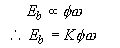
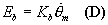
Whenever a conductor moves in a magnetic field, a voltage Vb is generated across its terminals . This voltage is known as back e.m.f. which is proportional to velocity of the conductor in the field () & magnetic flux .
But in case of Permanent magnet stator flux is constant. So we will have


 is the generalised force or torque acting at the joint which is produced by an actuator which may be electric, pneumatic or hydraulic. Study of Robot dynamics gives us force or torque requirement imposed by Robot manipulator which actuator have to supply. So it is necessary to study the actuator dynamics alongwith Robot dynamics as Control Problem of Robot manipulator lastly gets converted into Control of Actuator.
 = torque supplied by motor


 substituting this into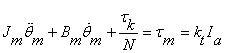
 ) & magnetic flux
 .
.