DRIVING TORQUE and INERTIA TORQUE
Gas forces due to the internal combustion of fuel, drive the piston's motion which is transmitted through the connecting rod to the crank. as shown in Fig. 3.10. An expression for the “driving torque” or “gas torque” is given by:
 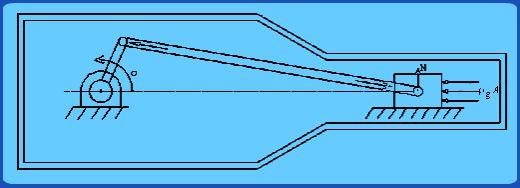
Figure 3.10
For a four-stroke cycle, power is delivered only in one stroke. Thus the gas torque varies with time. When such a source is used as a prime mover, instantaneous speed of the shaft fluctuates from time to time within a cycle of rotation, depending on the “load torque” requirement. If the load torque ideally matches the driving torque at every instant, the speed will be theoretically uniform. Thus in general we will need a device to “iron out” these fluctuations in shaft speed within a cycle. Such a device is known as “flywheel” and we shall discuss it in greater detail in a later module.
By replacing the gas pressure by inertia force due to  (i.e., (i.e.,
 ), we can estimate the “shaking moment” or “inertia torque” as follows: ), we can estimate the “shaking moment” or “inertia torque” as follows:

|


