Haug highlights the illusion of incompleteness created by the commodity:
“In these images, people are continually shown the unfulfilled aspects of their existence… Commodity aesthetics' ideal would be to invent something which enters one's consciousness unlike anything else; something which is talked about, which catches the eye and which cannot be forgotten; something which everyone wants and has always wanted.”
The purpose is to create something which is not there, something that enters our consciousness and tells us that a certain commodity is not only what everyone wants but interestingly something that everyone has always wanted . So all aspects of our life are shown to be unfulfilled and less successful if we did not go for the commodity. One of the important goals of Cultural Studies is to explore and show the signs and the codes, the meanings that emanate from the phenomenon of commodity fetishism. Cultural Studies has always tried to show that there are realities of power and politics, of economic and social power, of cultural capital in our cultural practices.
Chris Barker holds that the design and production of objects or commodities always go through a process of modification.
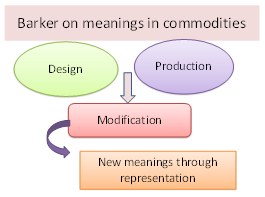
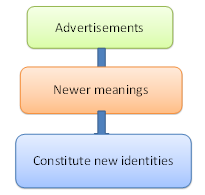
In contemporary constructions of meaning rapid changes are backed by rapid modifications in design and production of commodities. Every production and modification of commodities leads to new meanings through representation processes. If we see how commodities are sold, advertised or marketed in the past we shall notice how these have changed rapidly. They create new identities as their representations keep changing because of their modifications of design in a bid to get more people to buy those commodities. Advertisements create newer meanings and constitute new identities. When the introduction and creation of new meanings and identities are saturated, then begins a whole circle of further modifications and their representations.