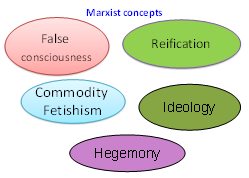
So when we study the commodity the first theory that comes to our mind is Marxism. In the study of the commodity there are related terms from Marxist discourses like false consciousness, reification, commodity fetishism, ideology and hegemony, some of which we are acquainted with from our previous lectures.
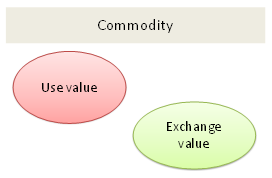
Interestingly in Das Kapital Marx does not begin his work with grand theories or grand abstractions and formulations but with what we may call the basic unit – the ‘atomic' unit so to speak – of political economy, that is, the commodity. Indeed what the molecule is to the study of biology the commodity perhaps is to the study of political economy. Marx proposed that a commodity has two kinds of values:
• Use value: every commodity has utility; a pen or a piece of clothing – whether it is for exchange or not – has a certain utility or use value; it is useful to us.
• Exchange value: on the other hand a commodity also has an exchange value: it can be exchanged for another item, say for instance in a barter system or as in the market against a common measuring mechanism like money. Therefore it follows that a thing may have use value and at same time it may not have exchange value.