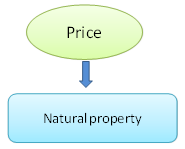
Therefore the price of a commodity which comes about through complex arrangements of the market which are man-made now seems to be a natural property of that commodity. As we have seen earlier, the relations of production and particularly the system of exploitation that goes on in the capitalist system are hidden when the commodity is transformed into fetishized object. In such a scenario the price of a commodity is seen as already a given. Commodity fetishism is therefore related to the surface appearance of an object.
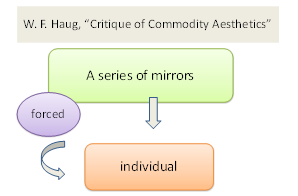
W. F. Haug in an essay entitled “Critique of Commodity Aesthetics” argues that when we consider the aesthetics of the commodity we find that we are provided with a series of mirrors that is forced on to the consumer. The commodity in its final aesthetically pleasing form is a mirror in which the individual contemplates himself or herself.
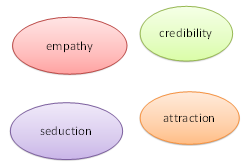
What does an individual therefore see there? According to Haug, the commodity invokes the qualities of empathy, credibility, seduction and attraction. The commodity empathizes with our needs, desires and at the same time we empathize with it. Secondly, the aestheticised commodity also tells us that it has a certain degree of credibility and that is why we have to own it. It is also seductive in its final form in the sense that one is seduced into procuring the object, and of course in its aestheticised form it is also one that can be extremely attractive. In the ‘mirror' of commodity aesthetics the individual perceives empathy, credibility, seduction and attraction.