The only solution to this, and it is essential in systems of more than about six capacitors in series, is to have charge equalization circuits . These are circuits connected to each pair of capacitors that continually monitor the voltage across adjacent capacitors, and move charge from one to the other in order to make sure that the voltage across the capacitors is the same.
These charge equalization circuits add to the cost and size of a capacitor energy storage system. They also consume some energy, though designs are available that are very efficient, and which have a current consumption of only 1mA. A Ragone plot comparing supercapacitors with batteries is shown in Fig. 3
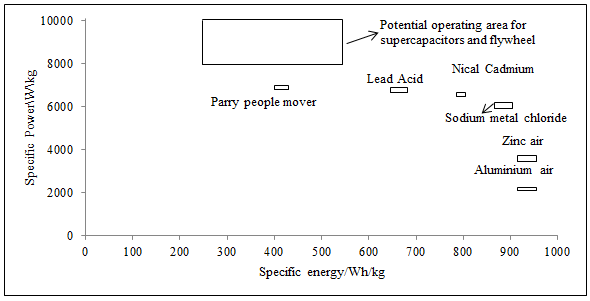
Fig. 3 Ragone plot of batteries, supercapacitors and flywheels
In many ways the characteristics of supercapacitors are like those of flywheels. They have relatively high specific power and relatively low specific energy. They can be used as the energy storage for regenerative braking. Although they could be used alone on a vehicle, they would be better used in a hybrid as devices for giving out and receiving energy rapidly during braking and accelerating afterwards, e.g. at traffic lights. Supercapacitors are inherently safer than flywheels as they avoid the problems of mechanical breakdown and gyroscopic effects. Power electronics are needed to step voltages up and down as required. Several interesting vehicles have been built with super capacitors providing significant energy storage, and descriptions of these can be found in the literature .