The total amount of energy stored is given by the formula:
| E = 0.5Iω2 | (1) |
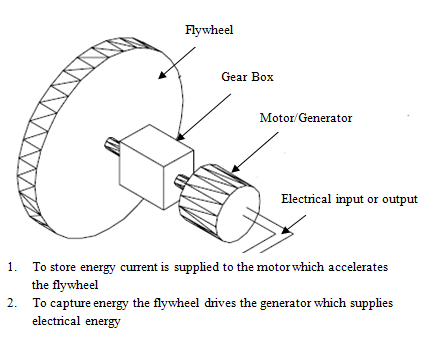
Fig. 1 Flywheel/generator arrangements
where E is the energy in joules, I is the moment of inertia and ω is the rotational speed in radians per second. When a flywheel reduces from ω1 to ω1 rad s-−1 the energy released will be given by the formula:
 |
(2) |
If you could make a flywheel strong enough almost infinite energy could be stored, bearing in mind that the mass and hence the moment of inertia get larger as the flywheel peripheral speed approaches the speed of light. Unfortunately as the flywheel rotational speed increases so do the stresses in the material. As a result the flywheel's energy storage capacity is limited by the tensile strength of the material it is made from.
The main advantage of flywheels is that they have a high specific power and it is relatively easy to get energy to and from the flywheel. They are also fairly simple, reliable mechanical devices. The specific energy from flywheels is limited and unlikely to approach that of even lead acid batteries. Attempts have been made to boost specific energy by using ultra-strong materials, running the flywheel in inert gas or a vacuum to reduce air friction losses, and using magnetic bearings.
Apart from the low specific energy there are major worries about safety due to the risk of explosion. In the event of the flywheel rupturing, during a crash energy is released almost instantly and the flywheel effectively acts like a bomb. Also, if a fast moving flywheel becomes detached from its mountings it could cause real havoc. Another aspect of flywheels that needs to be considered is the gyroscopic effect of a disc rotating at high speeds. Firstly, without outside interference they tend to stay in one position and do not readily move on an axis other than the axis of spin. When a torque or movement is introduced around one axis, the flywheel tends to move or process around another axis. Again the behavior in an accident situation needs to be studied carefully, as does the effect on the vehicle's dynamics. However, it should be noted that in many cases these effects could be benign, and they could have a smoothing effect on vehicle ride.
Despite the lack of success of the flywheel for vehicle energy storage and a certain amount of bad press, it would be wrong to write off the flywheel completely. Virtually all IC engines have small flywheels and these have not proved particularly problematic. The simplicity of a small flywheel to be used in an electric vehicle for use as a regenerative braking system should not be overlooked. Provided the flywheel is used well below its rupture point and is kept relatively small and well guarded, it may come to have a useful role in the future of electric vehicles, particularly in hybrids.
Super Capacitors
Capacitors are devices in which two conducting plates are separated by an insulator. An example is shown in Figure 2 . A DC voltage is connected across the capacitor, one plate being positive the other negative. The opposite charges on the plates attract and hence store energy. The charge Q stored in a capacitor of capacitance C Farads at a voltage of V Volts is given by the equation:
| Q = C X V | (3) |